Uni-Lab-OS 1.0 Official Release: Connecting Devices with Intelligence, Connecting Us with Insight
In the era of AI for Science, where research workflows are being fundamentally reshaped, the ability to acquire high-throughput, high-quality data has become the key competitive edge. Yet today’s labs still face major challenges: heterogeneous hardware, closed protocols, and fragmented data flow force researchers to spend precious time on integration overhead—not scientific discovery.
An automated lab should not be a collection of expensive machines, but an extension of intelligent decision-making.
In December 2025, with the official merge of v0.10.13, Uni-Lab-OS enters version 1.0. We aim to provide a standardized digital infrastructure for the scientific community—breaking down device barriers and freeing innovation from tooling constraints.
I. Breaking the Deadlock: An “Operating System” for the Laboratory
Uni-Lab-OS is an AI-native, distributed operating system co-initiated by the DeepModeling open-source community and DP Technology. Inspired by ROS (Robot Operating System) in robotics, it bridges the gap between high-level experimental planning and low-level device execution through a software-hardware decoupled architecture.
The 1.0 release introduces a universal "laboratory semantic standard," enabling researchers to define automation workflows with intuitive, consistent logic—seamlessly translating intent into action.
II. Technical Deconstruction: Core Architecture of Uni-Lab-OS
Based on abstraction and refinement of a large number of scientific research scenarios, Uni-Lab-OS 1.0 achieves deep virtualization of the physical world at the architectural level, ensuring the generality and robustness of the system.
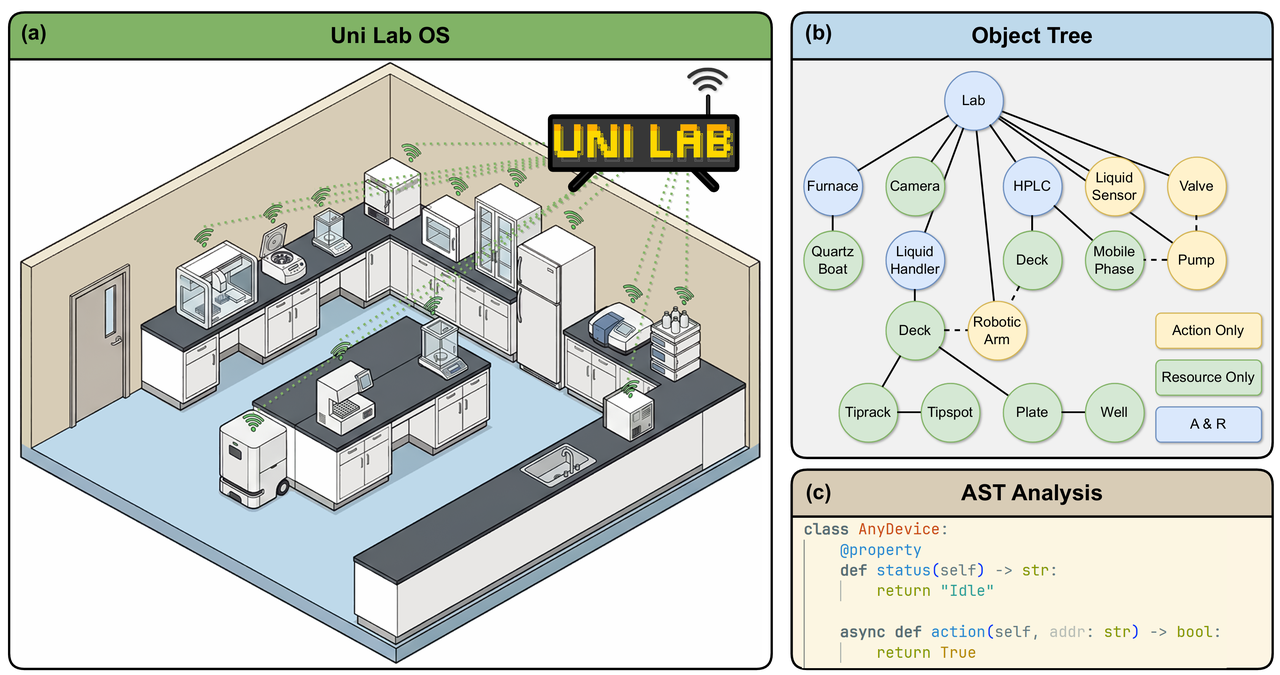
1. Everything Is an Object: The A / R / A&R Abstraction Model
To smooth out hardware differences across devices from different vendors and generations, Uni-Lab-OS introduces a strongly typed device abstraction layer, standardizing all laboratory entities into three categories of objects:
Resource (R): Material entities being operated on (such as sample vials and well plates), which only contain state information.
Action (A): Pure execution units (such as pumps and valves) that perform actions but do not hold materials.
Action & Resource (A&R): Composite entities that both store materials and perform actions (such as liquid-handling workstations and reactors).
This standardized abstraction design allows upper-layer applications to invoke device capabilities through standard APIs without needing to concern themselves with underlying hardware details, greatly lowering the development barrier.
To enable the portability of experimental protocols, Uni-Lab-OS maintains two distinct topological structures, achieving separation between logic and physical implementation:
Logical Resource Tree:
Defines ownership and hierarchical relationships of resources (e.g., room–bench–tray–well), and is used for permission management and task scheduling.Physical Graph:
Defines the reachability of fluid pipelines and robotic arms, and is used for runtime path planning.
This design ensures that the same experimental logic can be flexibly adapted to different hardware connection schemes, truly realizing the “code-ification” and “migratability” of experimental workflows.
2. Data Integrity: The CRUTD Protocol
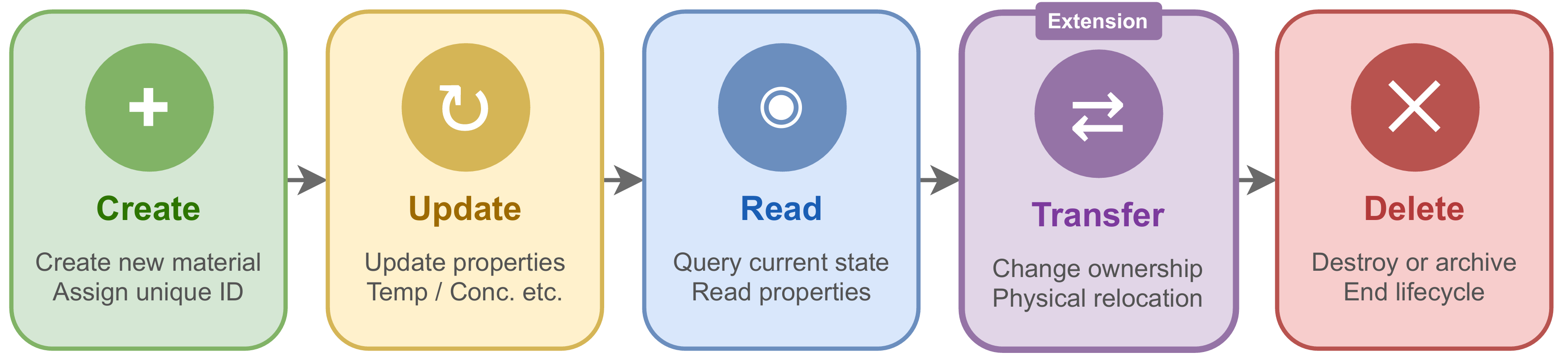
Unlike the traditional CRUD (Create, Read, Update, Delete) model of databases, Uni-Lab-OS introduces the Transfer operation and constructs the CRUTD protocol.
Transfer is defined as an atomic transaction with spatiotemporal attributes, ensuring full-process, high-fidelity data traceability throughout the experimental lifecycle, and providing a reliable foundation for downstream data analysis and modeling.
3. Distributed Resilience: Edge–Cloud Collaborative Architecture
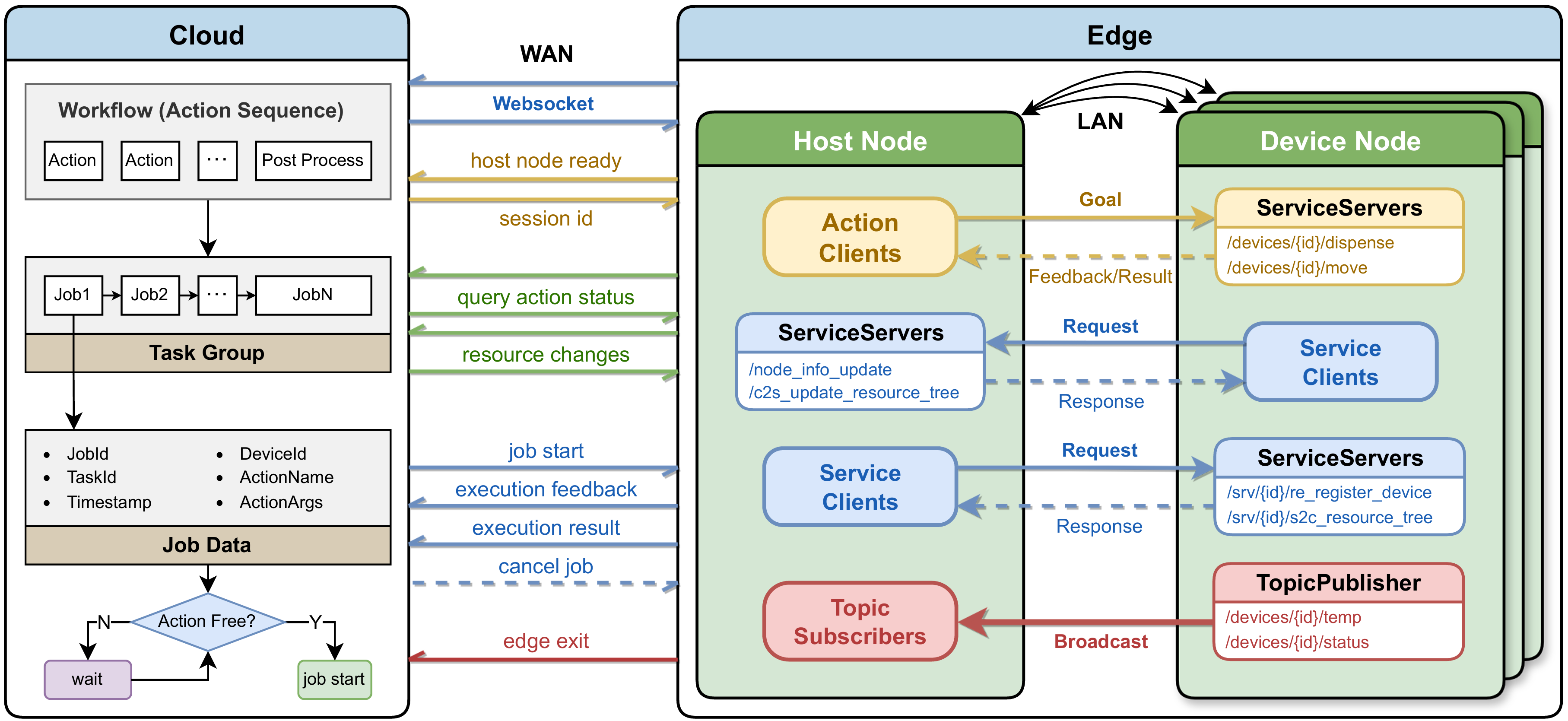
The system adopts a decentralized communication architecture based on ROS 2 and DDS (Data Distribution Service).
Peer-to-peer (P2P) communication and self-discovery mechanisms are supported among edge nodes. Even under extreme conditions such as external network outages, local laboratory workstations are still able to operate safely and stably, ensuring the continuity of experiments.
III. Evolution: The Open-Source Journey from v0.8 to v1.0
The maturity of Uni-Lab-OS is a technological long-distance run spanning 365 days, jointly completed by more than 20 developers.
2025.04 (v0.8.0):
The project was officially open-sourced, establishing the direction of the underlying architecture.2025.06 (v0.9.5):
MoveIt2 motion planning and a virtual device system were introduced, realizing “virtual–physical interconnection.”2025.10 (v0.10.7):
Workstation templates and standardized installation procedures were released, enabling stable handling of various industrial-grade scenarios.2025.12 (v0.10.13–v1.0):
Post-processing workstations, visual feedback modules, and a full-stack driver library were added, comprehensively covering core scenarios such as liquid handling, materials characterization, and organic synthesis.
Looking ahead, version 1.0 is only a starting point. In subsequent version plans, we will focus on improving system usability and intelligence:
Lightweight Deployment:
Deep optimization for non-ROS environments to lower deployment barriers, allowing the system to run smoothly on standard industrial control computers and even lightweight devices.Operations-Friendly Design:
The introduction of a more intuitive laboratory operations and maintenance management interface, enabling visualization of device status monitoring, consumables management, and task scheduling, so that the system evolves from “usable” to truly “easy to use.”
IV. Ecosystem: From Observers to Co-Creators
Open source is not merely about making code public; it is about the convergence of collective intelligence. Over the past year, the Uni-Lab-OS team has continuously engaged with universities and research institutes, hosting three offline developer workshops in Shanghai, Beijing, and Yibin.
We worked side by side with more than 150 developers from diverse backgrounds—including biomedicine, materials science, computational chemistry, and mechanical engineering—conducting code debugging and workflow validation directly alongside real laboratory equipment. We are pleased to witness a qualitative transformation within the community: from “users of tools” to “creators of tools.”
Automation is no longer a game reserved for a select few. In the past, many perceived laboratory automation as having prohibitively high barriers, excessive costs, and unclear pathways. Yet through repeated workshops, we have seen a different possibility emerge. When automation is no longer mysterious and tools become accessible, every laboratory can cultivate innovations of its own.
V. Conclusion
Building the laboratories of the future cannot rely on isolated efforts alone. We sincerely invite research groups from universities and research institutions to join us in jointly creating benchmarks for intelligent laboratories.
Connecting devices with intelligence, connecting people with insight—the future of automated laboratories is not somewhere else; it is in our own hands.
Accessing Uni-Lab-OS 1.0
Obtain the Uni-Lab-OS 1.0 source code:
https://github.com/deepmodeling/Uni-Lab-OSUni-Lab-OS project documentation:
https://deepmodeling.github.io/Uni-Lab-OS/Learn more technical details about Uni-Lab-OS:
https://arxiv.org/abs/2512.21766v1