What Can ABACUS Do Too? | Enhanced Shift Current in GeTe/SnSe Heterostructures for Bulk Photovoltaic Effect
I. Introduction
Recently, a research team from the Institute of Artificial Intelligence, Hefei Comprehensive National Science Center, and the CAS Key Laboratory of Quantum Information, University of Science and Technology of China, published a research article titled "Enhanced shift current in GeTe/SnSe heterostructures for bulk photovoltaic effect" in the authoritative journal in the field of computational materials, npj Computational Materials.
Utilizing the first-principles calculation software ABACUS and the physical property analysis software PyATB, the research team systematically investigated the shift current response in GeTe/SnSe van der Waals heterostructures. The study found that interlayer coupling can significantly enhance the bulk photovoltaic effect, and altering the interlayer stacking configuration can even tune or reverse the direction of the photocurrent, providing new theoretical insights for the design of two-dimensional photovoltaic materials.
II. From Monolayer Materials to van der Waals Heterostructures
The bulk photovoltaic effect can directly generate a direct current (DC) photocurrent inside non-centrosymmetric materials without relying on the built-in electric field in traditional p–n junctions. Among these, the shift current originates from the real-space displacement of the center of the electron wave packet during the photoexcitation process, which is closely related to the material's band structure, orbital hybridization, and quantum geometric properties.
Two-dimensional group-IV monochalcogenides such as GeTe and SnSe exhibit strong shift current responses. However, the strong response in monolayer materials is usually concentrated within a narrow energy range, and current contributions in opposite directions may appear in some energy regions, thereby reducing the effective output after integration over the solar spectrum.
To broaden the spectral response, the research team proposed constructing van der Waals heterostructures from two-dimensional materials with different bandgaps, utilizing complementary optical transitions to cover a wider energy range. Based on this idea, the team systematically investigated various group-IV monochalcogenide heterostructures, and the results showed that the GeTe/SnSe heterostructure exhibits the strongest overall shift current response.
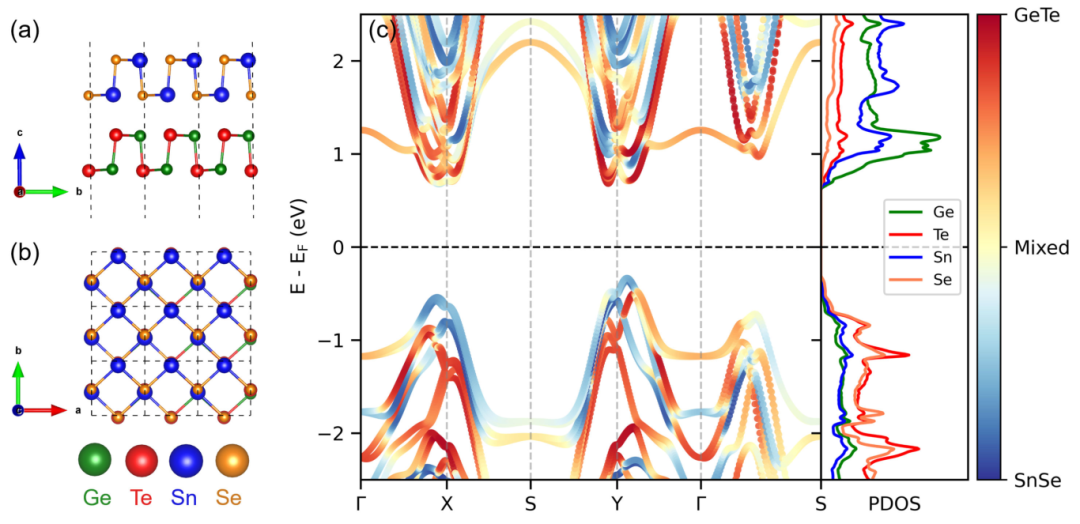
Figure 1: Structure, band structure, and projected density of states of the GeTe/SnSe heterostructure.
Structural and phonon spectrum calculations indicate that the GeTe/SnSe heterostructure possesses good stability. Its bandgap is approximately $0.98\ \mathrm{eV}$, and there is obvious GeTe–SnSe interlayer orbital hybridization near the band edges, indicating that the electronic structure of the heterostructure is not a simple superposition of the two monolayers.
III. Stronger and Broader Shift Current Response
Calculation results show that the linear optical response of the GeTe/SnSe heterostructure can be roughly regarded as a combination of the contributions from the two monolayers, but its shift current response exhibits a distinct synergistic enhancement.
In the near-infrared–visible light response range of $1-3\ \mathrm{eV}$, the heterostructure exhibits multiple strong shift current peaks, with peak values exceeding $3.0\ \mathrm{mA\cdotÅ/V^2}$, which are significantly higher than those of monolayer GeTe and SnSe.
More importantly, monolayer GeTe exhibits a relatively obvious alternating positive and negative response at different photon energies, whereas the GeTe/SnSe heterostructure is dominated by currents of the same sign in the main response energy region, thereby reducing mutual cancellation during the integration over the solar spectrum.
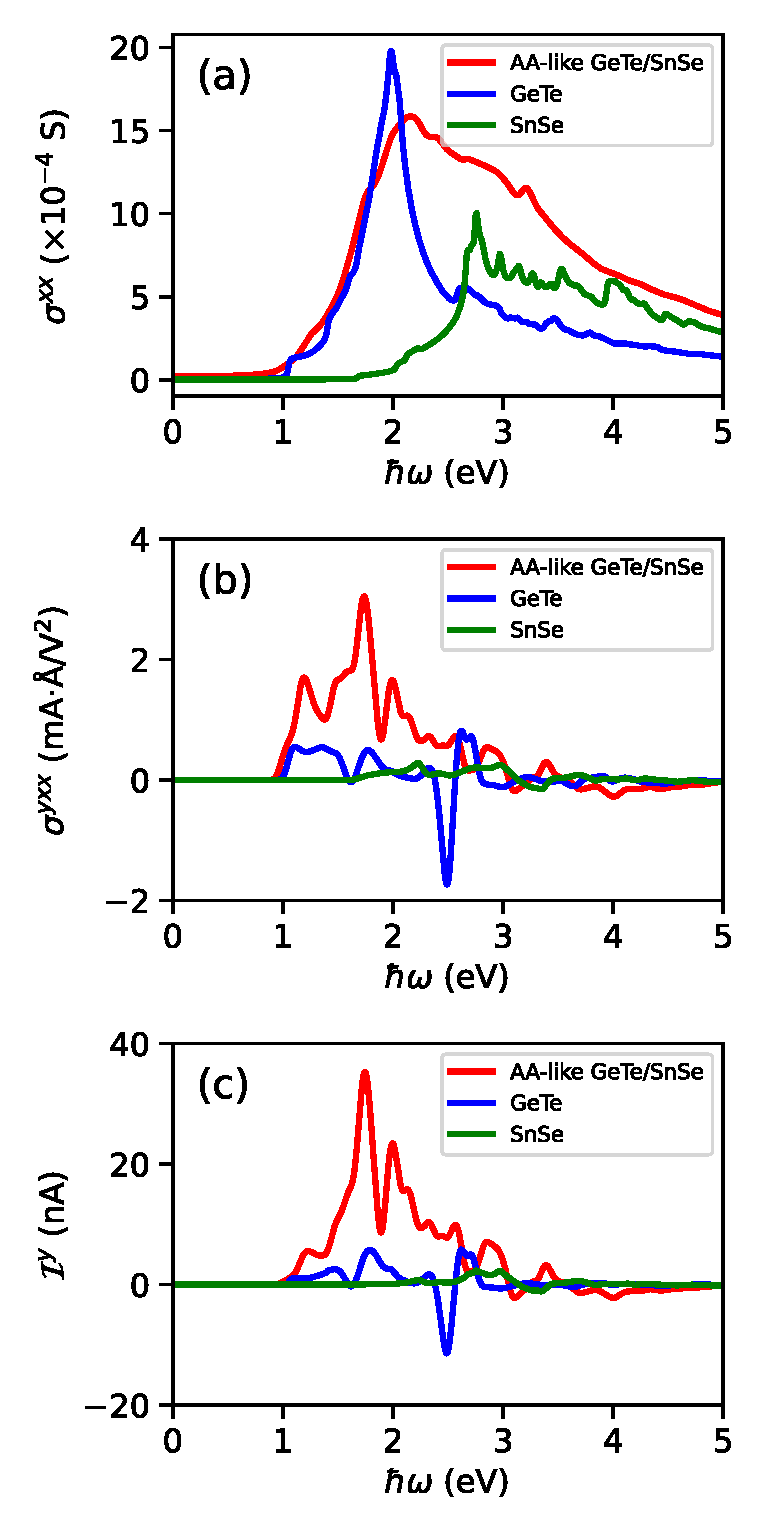
Figure 2: Comparison of optical response and short-circuit current between monolayer GeTe, monolayer SnSe, and the GeTe/SnSe heterostructure.
Under AM1.5 standard solar illumination, the two-dimensional short-circuit current density of the GeTe/SnSe heterostructure reaches $J_x^{2\mathrm D}=31.43\ \mathrm{nA/m}$ and $J_y^{2\mathrm D}=43.60\ \mathrm{nA/m}$. Compared to the monolayer systems, the short-circuit current densities in the two directions are increased by over (136%) and (158%), respectively.
This indicates that the heterostructure not only enhances the shift current peaks within local energy ranges but also improves the effective photocurrent output across the solar spectrum.
IV. Synergistic Enhancement from Interlayer Coupling
To rule out the influence of lattice-matching strain, the research team further calculated monolayer GeTe and SnSe with the same in-plane lattice constants. The results show that strain alone can only induce minor changes in the response, which cannot explain the significant enhancement in the heterostructure.
Band-decomposed analysis reveals that the main shift current contributions are concentrated near the (Y) point in the Brillouin zone. The band-edge electronic states in this region exhibit obvious GeTe–SnSe orbital hybridization, whereby interlayer coupling reconstructs the optical transitions and transition matrix elements, enhancing the shift current response.
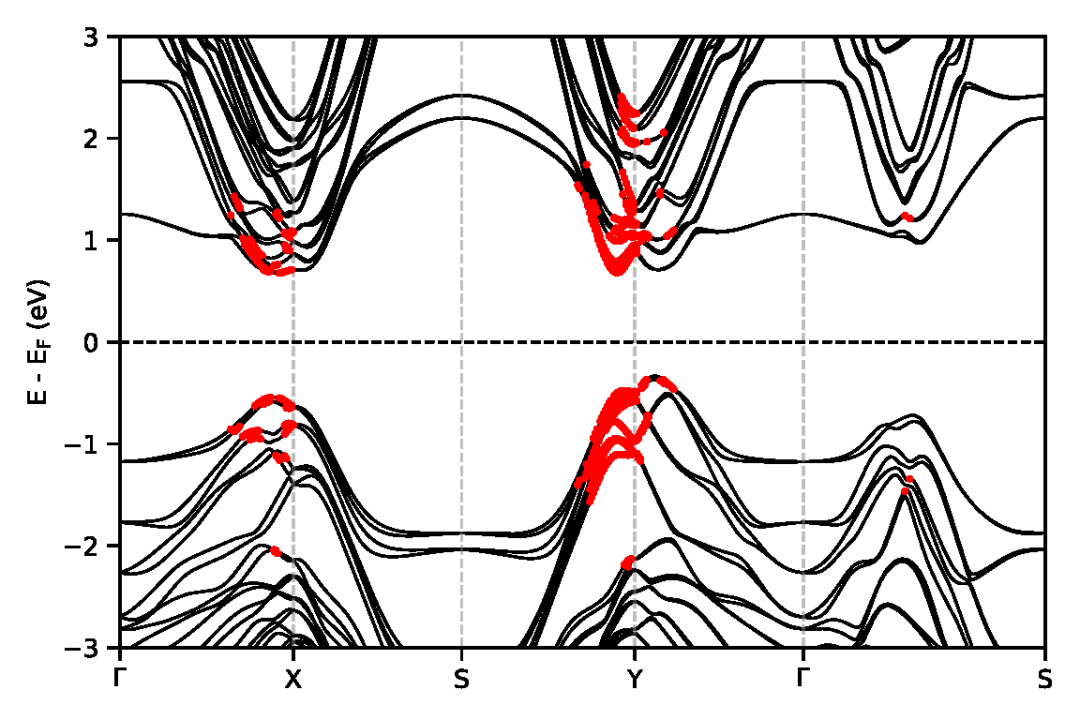
Figure 3: The main band contributions to the shift current are concentrated near the (Y) point.
Therefore, the enhanced bulk photovoltaic effect in the GeTe/SnSe heterostructure mainly originates from two aspects:
Interlayer orbital hybridization enhances the relevant optical transitions; the same-sign response over a broader energy range reduces current cancellation between different photon energies.
V. Tuning Photocurrent Direction via Interlayer Sliding
Van der Waals heterostructures also possess flexible degrees of freedom in interlayer stacking. The study found that when the GeTe and SnSe layers undergo relative sliding, the overall band structure of the system changes little, but the shift current response can undergo significant changes.
For the representative translation configuration (T(0.50,0.75)), the shift current of the heterostructure in the main response energy region exhibits a clear sign reversal.
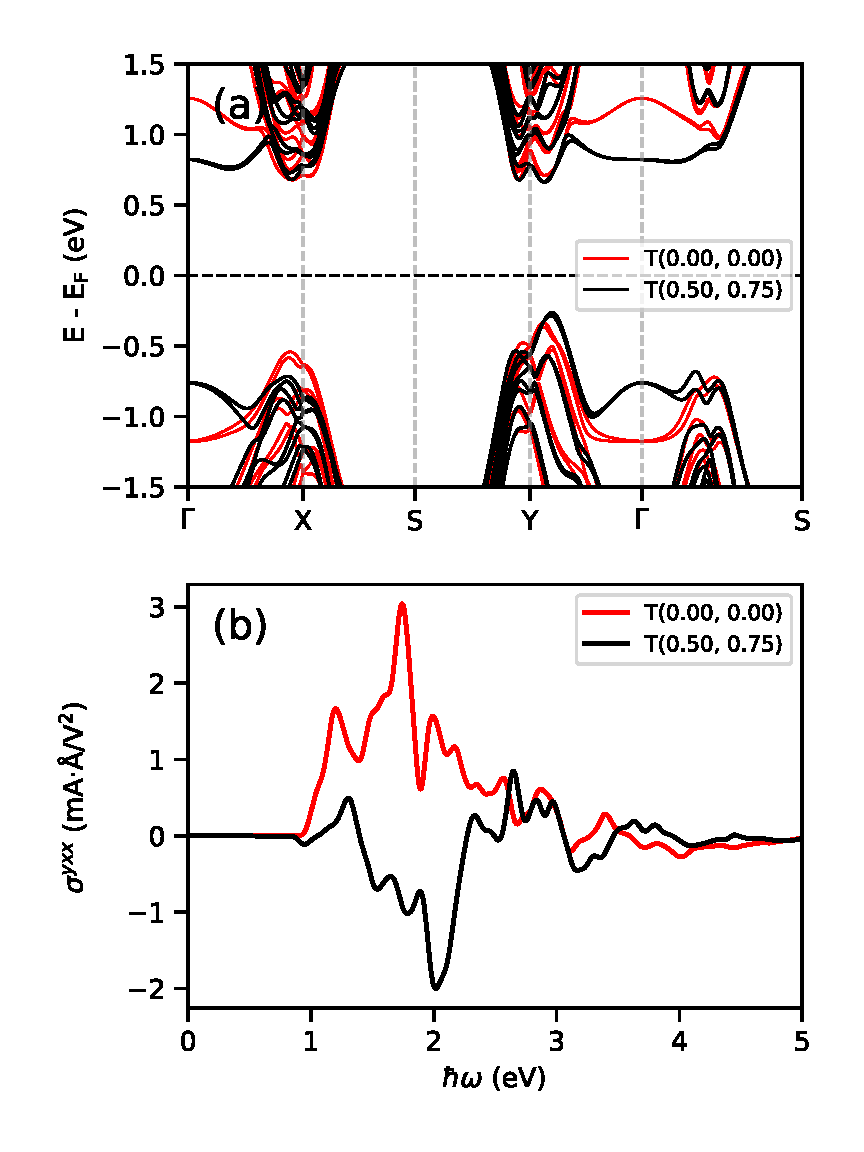
Figure 4: Band structure and shift current response of the heterostructure before and after interlayer sliding.
The reason lies in the fact that interlayer sliding alters the evolution of the GeTe–SnSe hybridized orbitals with crystal momentum, thereby changing the sign of the shift vector. This indicates that interlayer stacking can not only tune the magnitude of the photocurrent but also control its direction.
This study demonstrates that constructing van der Waals heterostructures from two-dimensional materials with different bandgaps, and further utilizing interlayer coupling and stacking degrees of freedom to tune the electronic structure, is an effective pathway to enhance and manipulate the two-dimensional bulk photovoltaic effect.
VI. Conclusion
In this study, the ABACUS software was used to perform structural optimization and electronic structure calculations of the heterostructure, while the PyATB software was utilized to calculate the band structure, linear optical response, and shift current. The combination of ABACUS and PyATB enables efficient calculations from first-principles electronic structures to second-order nonlinear photoelectric responses, providing a complete computational toolchain for the study of Berry phase-related physical properties and the bulk photovoltaic effect in complex materials.
VII. Article Information
Jin, G., Zhu, X. & He, L. Enhanced shift current in GeTe/SnSe heterostructures for bulk photovoltaic effect. npj Computational Materials 12, 245 (2026).
DOI:
https://doi.org/10.1038/s41524-026-02122-w
ABACUS Website:
http://abacus.ustc.edu.cn
PyATB Website:
https://github.com/pyatb