What Can ABACUS Do Too? | Theoretical Study of TiO₂ Phase Stability through DFT+U and Machine Learning
1. Introduction
In April 2026, a research team from the Materials Genome Institute and the School of Computer Engineering and Science at Shanghai University, together with researchers from the Department of Computer Science at the University of Tsukuba, Japan, published a research paper titled “Theoretical study of TiO₂ phase stability through DFT+U and machine learning” in the internationally renowned journal Computational Materials Science. Based on the open-source density functional theory software ABACUS, this work innovatively combines machine learning with DFT+U calculations and proposes a data-driven strategy to identify electron densities that can simultaneously match multiple experimental properties, providing a new approach to resolving the long-standing contradiction between theory and experiment in the phase stability of titanium dioxide (TiO₂).
2. Research Background
Titanium dioxide (TiO₂) is widely used in photocatalysis, solar cells, and other fields because of its high stability, low cost, and non-toxicity. Experimental results show that among the three common TiO₂ crystal phases (rutile, anatase, and brookite), the rutile phase is the most stable. However, DFT calculations based on different density functionals yield different results — many calculations predict that the anatase phase is more stable, and the band gaps of all three phases are underestimated to varying degrees. This discrepancy between theory and experiment has puzzled the research community for many years. Traditional solutions, such as high-precision hybrid functionals and DFT+U corrections, often achieve agreement with experiment only for a single property such as energy or band gap, and it is difficult to achieve consistency across multiple properties simultaneously. Finding a suitable set of electron densities that makes the energy ordering and band gaps of the TiO₂ phases simultaneously match experiment has become an urgent scientific problem.
3. Overview of Results
(1) Research Methods
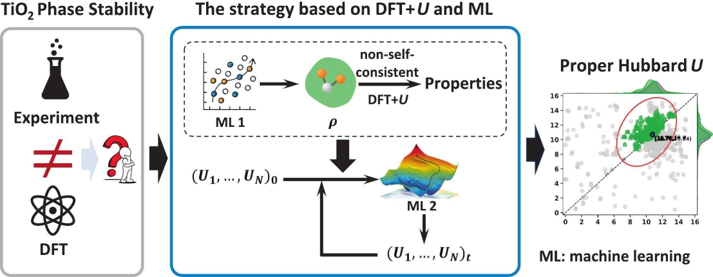
Figure 1: The TiO₂ crystal phase stability obtained from conventional DFT calculations does not match experimental results. To address this, the researchers constructed a dual machine learning scheme combined with DFT+U. ML1 directly predicts the electron density through machine learning, bypassing self-consistent iteration and enabling fast non-self-consistent DFT+U property calculations. ML2 then uses a multi-objective optimization algorithm to iteratively search for the optimal Hubbard U parameters, ultimately identifying precise U values that fit the energies and band gaps of rutile, anatase, and brookite simultaneously, providing a new approach to the problem of mismatch between theoretical and experimental properties.
This study proposes an innovative strategy that integrates machine learning with DFT+U calculations. Using the ABACUS software (v3.9.0), the PBE exchange–correlation functional, and ONCVPSP pseudopotentials, the researchers performed DFT+U calculations for the three TiO₂ crystal phases: rutile, anatase, and brookite, with Hubbard U values ranging from 0 to 15 eV. They then decomposed the self-consistent electron density into atomic electron densities and used these to train machine learning models, enabling rapid prediction of the self-consistent electron density for arbitrary U values and improving the efficiency of DFT+U calculations by more than 20 times. On this basis, a multi-objective optimization algorithm was used to efficiently search for Hubbard U parameter combinations that can simultaneously satisfy the dual constraints of energy ordering and band gap.
(2) Main Research Results
Effect of Hubbard U on phase stability: Without U, the DFT-predicted energy order is anatase < brookite < rutile, opposite to the experimental result. When the same U value is applied to all crystal phases and is in the range of 3.9–5.0 eV, the energy ordering is restored to agreement with experiment.
Electron transfer mechanism: As U increases, electrons transfer slightly from Ti atoms to O atoms, the localization of Ti-3d orbitals increases, and Ti–O hybridization weakens, leading to band gap widening. PCA analysis shows that the variation amplitude of the electron density of Ti atoms is significantly larger than that of O atoms.
Multi-objective optimization identifies optimal U values: Through simultaneous optimization of the three crystal phases, the research team obtained optimal U value combinations that can satisfy both the energy ordering and band gap convergence criteria — rutile 10.35 eV, anatase 10.22 eV, and brookite 10.30 eV. Under these parameters, the band gaps given by non-self-consistent DFT calculations are in excellent agreement with experimental values (rutile 3.00 eV/calculated 2.90 eV, anatase 3.20 eV/calculated 3.22 eV, brookite 3.25 eV/calculated 3.24 eV).
Generality of the strategy: This method is not limited to the TiO₂ system but can be extended to parameter optimization studies of other strongly correlated materials, providing a methodological foundation for cross-system applications.
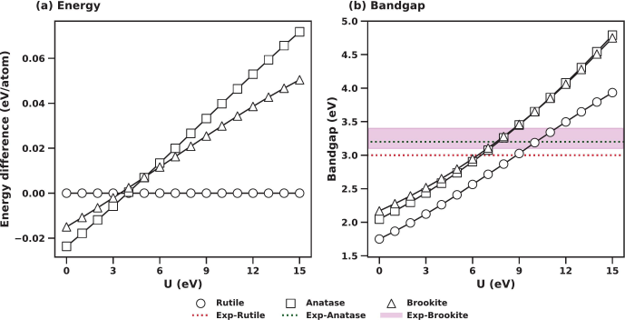
Figure 2. Effects of Hubbard U on the energy differences and band gaps of the three TiO₂ crystal phases. Figure 1(a) shows that when U > 3.5 eV, rutile becomes more stable than brookite; when U > 3.9 eV, rutile also becomes more stable than anatase, and the energy ordering is consistent with experiment. Figure 1(b) shows that the band gaps of all three phases increase monotonically with U, but with different rates, implying that a uniform U value cannot simultaneously match the experimental band gaps of all phases, thus motivating the need for a data-driven optimization strategy.
4. Conclusion
This work combines machine-learning-assisted electron density prediction with multi-objective optimization for the first time, resolving the contradiction in TiO₂ phase stability that “fitting a single property is easy, while matching multiple properties simultaneously is difficult,” and reveals the key role of electron density consistency in determining phase stability. The results not only provide a reliable parameter scheme for theoretical calculations of the TiO₂ system, but also provide a generalizable methodological framework for parameter optimization of strongly correlated material systems. Using the open-source density functional theory software ABACUS as the core computational engine for all DFT calculations, this study demonstrates the practical value of China-developed scientific computing software in frontier research on condensed matter physics and materials science, and contributes to building an autonomous and controllable computational materials science ecosystem.
Contact Us
Scan the QR code to follow “ABACUS”