10 Million Atoms on a Single GPU, 2.048 Billion Atoms on a Thousand GPUs | DPA4C Debuts: The World's Fastest General Machine Learning Potential
Accuracy Rivals Mainstream Models, Speed Surpasses Empirical Potentials: DPA4 OMat24 and OMol25 Pre-trained Models Unveiled
Whether a new material can withstand high temperatures, whether a battery will swell, or where an alloy part will crack—to answer these questions, the most thorough approach is to lay out the atoms in the material one by one, let them move according to physical laws, and play an "atomic-level movie" in a computer. This is cheaper and faster than actually smelting a batch, burning it, or breaking it.
Yet for decades, this movie has been stuck in the same place: you have to choose between fidelity and scale.
For high fidelity, you must rigorously calculate the force on each atom according to quantum mechanics. The results are accurate enough, but the cost is that you can only "film" a few hundred atoms at a time, with a "clip length" measured in picoseconds, and it still takes the computer days to calculate. For large scale, you have to replace this algorithm with a rough empirical formula. The speed immediately increases by several orders of magnitude, allowing you to easily simulate tens of millions of atoms. However, this formula often only works for one specific material; changing the composition requires retuning, which takes months.
Machine learning potentials were originally designed to "have it both ways." In recent years, they have indeed brought fidelity close to quantum mechanics and enabled a single model to handle hundreds of elements. Only speed has failed to keep up. The fastest universal models are still several orders of magnitude slower than that rough old formula.
DPA4C has now filled this final gap. It is currently the world's fastest universal machine learning potential: a single model covers almost the entire periodic table, with accuracy approaching quantum mechanics, and for the first time, its speed has entered the regime previously only reachable by empirical formulas.
- Universal: A single model covers almost the entire periodic table, and the smallest variant has only 29,809 parameters, with weights totaling less than 120 KB.
- Accurate: Trained on the hundred-million-scale first-principles dataset OMat24, its accuracy is close to the widely used MACE-Omat, yet its measured deployment throughput is about two orders of magnitude higher.
- Fast: On the same V100 GPU and in the same complete molecular dynamics benchmark, it is 1.84 times (diamond carbon) and 2.52 times (face-centered cubic copper) faster than the MEAM empirical potential, which has been used for over thirty years and only serves one material at a time.
- Large-scale: A single H20 GPU can simulate 14.05 million atoms simultaneously; on 1024 V100 GPUs, it scales to 2.048 billion atoms, equivalent to a small 0.18 × 0.18 × 0.36-micron piece of real diamond, while retaining over 80% efficiency.
- Cost-effective: Training each of the five variants from scratch on OMat24 takes only 6.8 to 35.2 hours on a single GPU; in the same comparison table, EquiformerV3 consumed 7,281.7 GPU hours.
Recently, the OpenLAM team at the Academy of AI for Science (AISI), in collaboration with Peking University, DP Technology, and the Institute of Applied Physics and Computational Mathematics, presented the overall progress of the DPA4 series: DPA4, representing the high-accuracy route, releases pre-trained models for OMat24 inorganic materials and OMol25 complex molecules; and the brand-new DPA4C makes its official debut.
The weight of this update is clearest when looking at two figures.
How to read them is simple. The further right on the horizontal axis, the faster the model computes; the vertical axis represents accuracy. Simply put, this is the scale and fidelity of the movie mentioned earlier. In the past, all models were constrained to the same curve: to be more accurate, you had to be slower; to be faster, you had to be rougher. This curve is called the Pareto frontier. Moving along the curve is just changing the trade-off; pushing the entire curve outward is changing the trade-off itself: after pushing it out, every level of accuracy you want is faster than before, and every speed you can afford is more accurate than before.
DPA4 and DPA4C have each pushed it once.
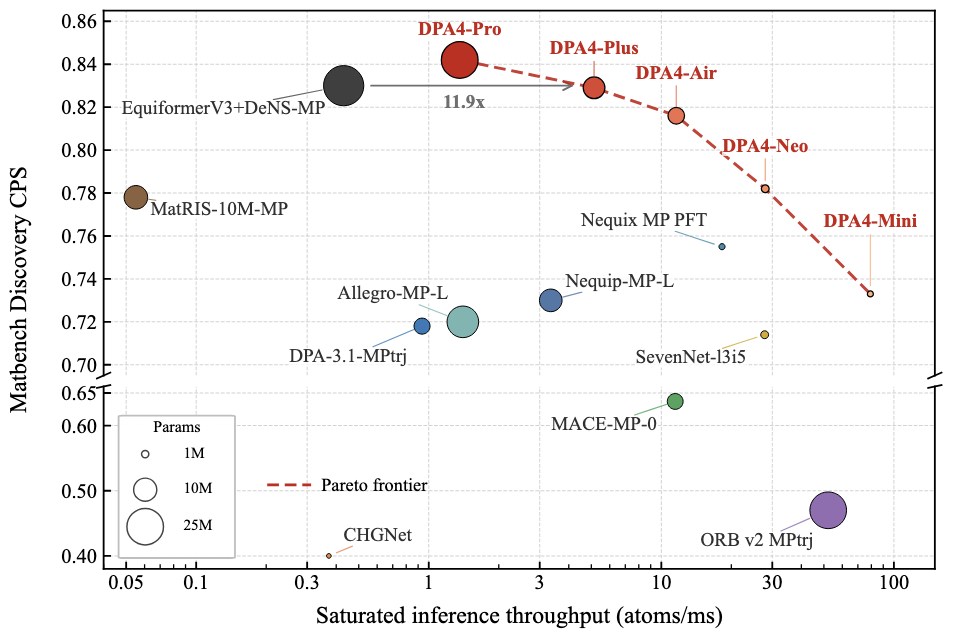
On Matbench Discovery, the entire accuracy-efficiency frontier (red dashed line) is exclusively occupied by the five DPA4 variants, with none of the other ten mainstream models falling on the line; at the same accuracy, the inference throughput of DPA4-Plus is 11.9 times that of the strongest baseline.
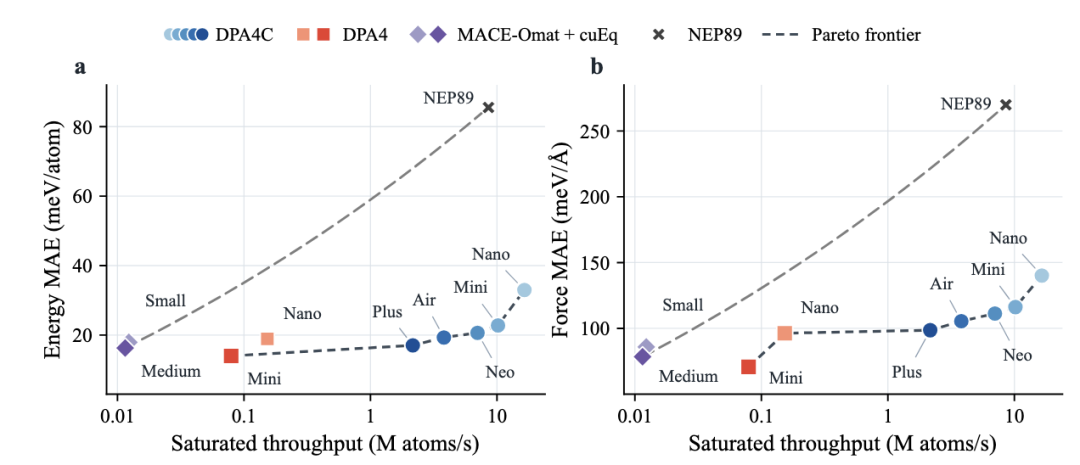
On OMat24, the gray dashed line is the only trade-off curve available before this work, and the dark dashed line is the new frontier established by DPA4C, with the entire frontier pushed to the right by about two orders of magnitude.
DPA4: Pushing High Accuracy to the Extremes of Inorganic Materials and Complex Molecules
After its debut in May this year, the new DPA4 paper extends training and validation to two hundred-million-scale datasets, OMat24 and OMol25; the DPA4 pre-trained models for practical use are also now available, offering multiple sizes for OMat24 and OMol25, which can be further fine-tuned or used directly for inference.
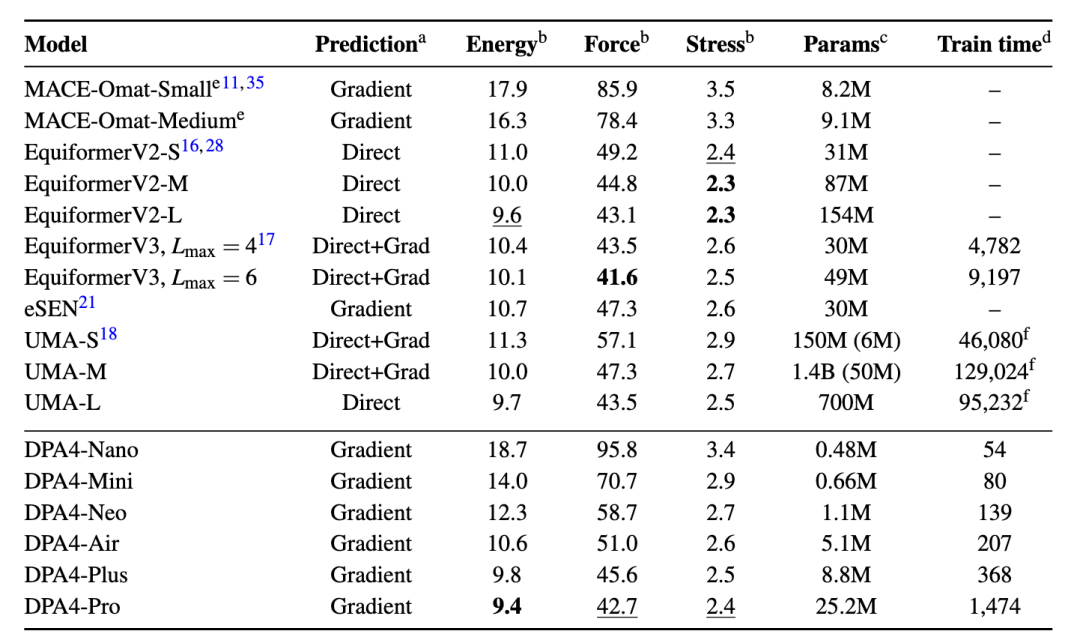
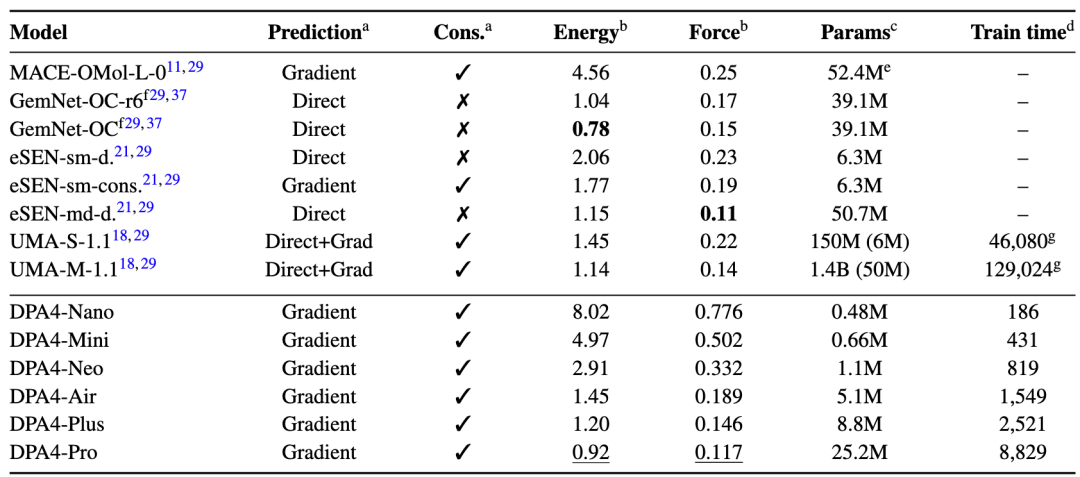
Accuracy comparison of DPA4 pre-trained models of different sizes on the OMat24 and OMol25 datasets.
OMat24 targets the large-scale inorganic materials space, while OMol25 covers complex molecular systems such as biomolecules, metal complexes, and electrolytes. After the massive expansion of the chemical space, the results delivered by DPA4 are:
- OMat24: DPA4-Pro achieves the lowest energy error (9.4 meV/atom); its force error is only 1.1 meV/Å away from EquiformerV3, while having about half the parameters and using about one-sixth of the training compute.
- OMol25: On the compositional extrapolation validation set, DPA4-Pro's total energy and force errors are both lower than those of the strongest conservative model in the comparison, UMA-M-1.1—the latter has 1.4 billion total parameters, while DPA4-Pro has only 25.2 million.
- Matbench Discovery: All five DPA4 variants fall on the accuracy-throughput frontier; DPA4-Pro leads in all ranking metrics, and DPA4-Plus matches the highest-scoring baseline with an inference throughput 11.9 times higher.
Combined, these three points illustrate the meaning of the first figure: DPA4 has pushed the "accuracy-efficiency" Pareto frontier forward by a large margin. Among the fifteen compliant models in Matbench Discovery, the entire frontier is composed exclusively of the five DPA4 variants, with none of the other ten mainstream models falling on the line. At the same accuracy, the inference throughput of DPA4-Plus is 11.9 times that of the strongest baseline; in the past, this level of accuracy would have required more than ten times the computational cost.
There is also a difference in the training approach. DPA4 exclusively uses conservative energy gradients throughout: forces are the negative gradients of energy with respect to coordinates, so the trained model naturally satisfies energy conservation and does not drift during long-term molecular dynamics. To save compute, many leading models pre-train with other objectives first and then fine-tune back, but DPA4 skips this step.
DPA4C: The World's Fastest Universal Machine Learning Potential
If DPA4 solves the problem of "whether it can be calculated accurately," DPA4C solves the problem of "whether it can be calculated affordably."
While maintaining quantum mechanical accuracy, it pushes the throughput of universal machine learning potentials into the speed regime of empirical potentials: tens of millions of atoms on a single GPU, and two billion atoms on a thousand GPUs. Achieving this is a model with as few as 30,000 parameters.
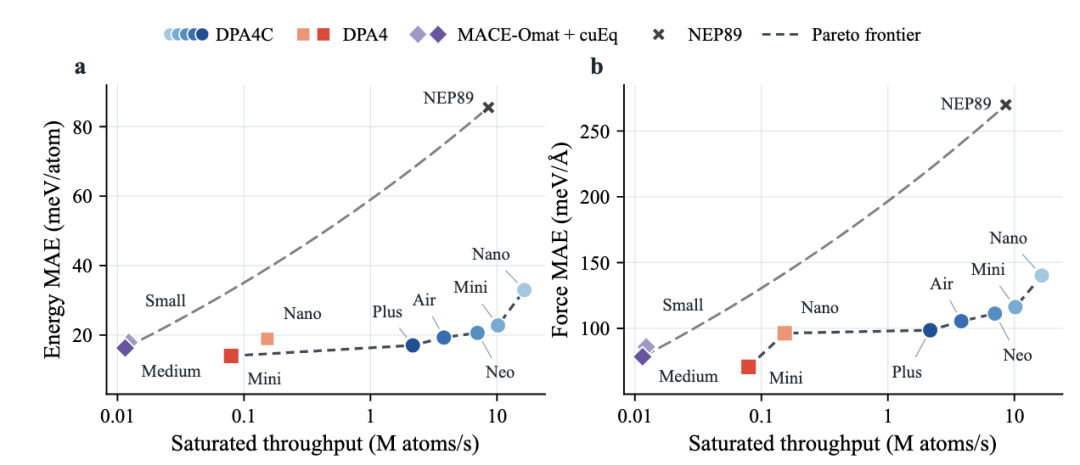
a is the energy error, b is the force error; the gray dashed line is the only trade-off curve available before this work, and the dark dashed line is the new frontier established by DPA4C.
The gray curve in the figure represents all the trade-offs you could make between "accuracy" and "speed" before this work: either accurate and slow like MACE-Omat, or fast and rough like NEP89, with every intermediate option falling on this line. The five DPA4C variants have pulled the entire frontier below the gray line and extended it to the right by two orders of magnitude. The area to the bottom right of the gray line, which was previously empty, is now entirely reachable.
DPA4C is first and foremost a universal machine learning potential: it is trained on quantum mechanical energy and force data, covering a broad chemical space from inorganic materials to organic molecules on OMat24, MatPES, and OMol25.
It is often misunderstood as "making the model smaller" or reverting to low-accuracy specialized potentials that only serve a single material. Neither is true.
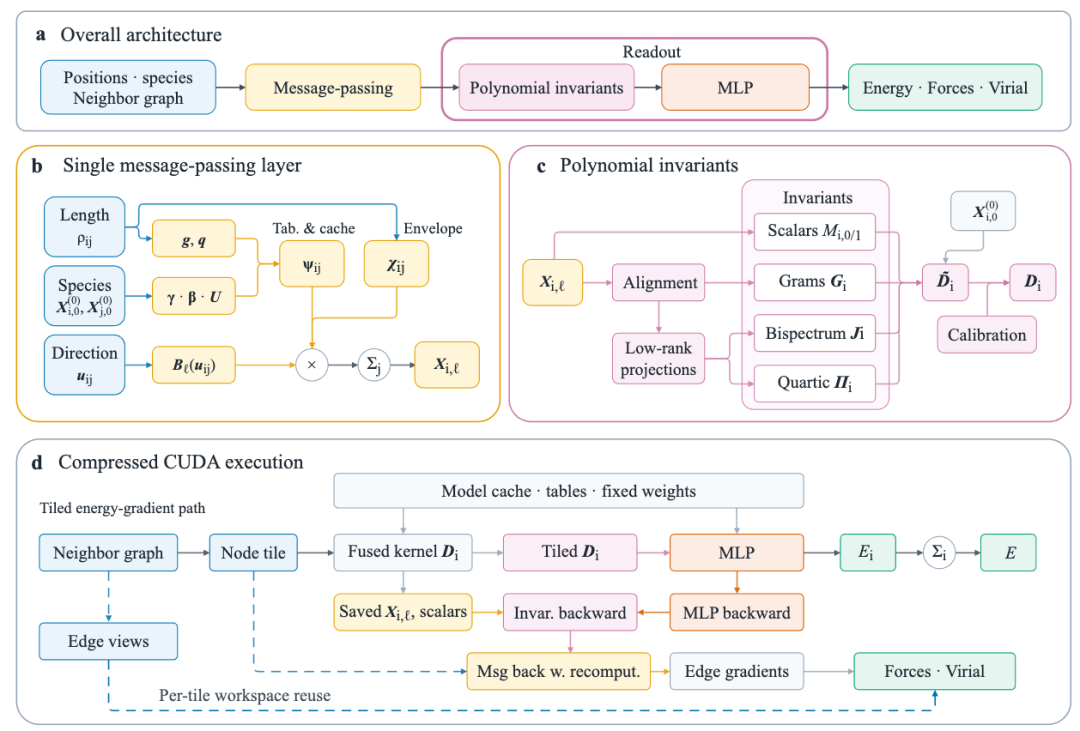
Schematic of the DPA4C model architecture and compressed execution path.
The "C" in DPA4C stands for Compact and Compressible. These two words describe two hard constraints in the architecture, established before the first line of code was written: the entire model was reverse-engineered from the condition that "it must ultimately run molecular dynamics on a GPU," rather than designing it first and then figuring out how to accelerate it.
Constraint 1: Every learnable function on an edge is only allowed to depend on two things: the distance between the two atoms and their respective elements. What this constraint buys is: during deployment, the entire "learned part" can collapse as-is into an interpolation table plus a finite cache. In the inference phase, the neural network practically no longer exists, leaving only table lookups and basic arithmetic. The paper compared the predictions before and after compression one by one on the 1.07 million validation structures in OMat24; the maximum difference was 0.00035 meV/atom in energy, which is negligible compared to the model's own error of tens of meV. This is what "compressible" means: equivalent replacement, not approximation.
Constraint 2: Every learnable state belongs only to a single atom and is processed in fixed-size chunks. Thus, the VRAM that grows with the system size is limited to the neighbor list and physical quantities like forces. Widening the model or increasing the angular momentum order only changes the computation within each chunk; no array spanning the entire system grows in size. This is why the five variants, despite a 49-fold difference in parameter count, reach the same upper limit of atoms on the same GPU.
Constraint 3: Only one layer of message passing is retained, and this layer only reads the coordinates and element types of neighbors. In multi-layer models, atomic features must propagate outward layer by layer, requiring the exchange of these "learned features" between processes during cross-GPU computation. DPA4C does not need to exchange them: it only passes coordinates and types across GPUs, and sends the forces back after computation. This is the direct reason it can maintain over 80% efficiency on 1024 GPUs.
Only after these three constraints are established does engineering come into play. DPA4C fuses the entire process of an atom from "reading neighbors" to "computing features" into a single CUDA kernel: a single warp sweeps through all neighbors of the atom, performing table lookups, element-pair modulation, truncation envelopes, and angular functions entirely in registers, accumulating on the fly. No intermediate quantity for any edge is ever written to VRAM. Backpropagation similarly does not save them but recomputes them, trading compute for memory.
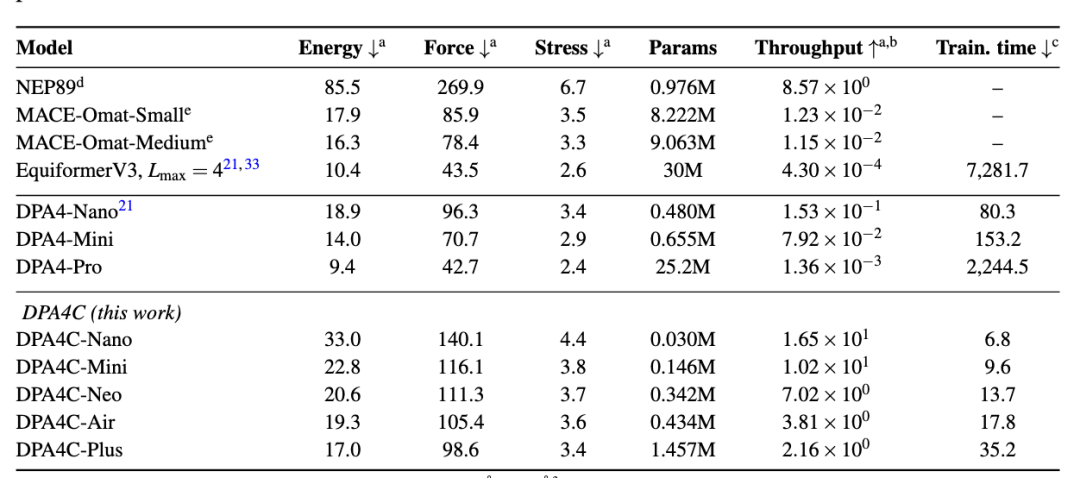
Accuracy, parameter count, throughput, and training cost of the five DPA4C model sizes on OMat24.
On OMat24, all five DPA4C variants fall on the empirically measured "accuracy-throughput" frontier. Three comparisons best illustrate the point:
- Compared to NEP89 (the previously fastest universal machine learning potential): DPA4C-Nano has only 3.1% of its parameter count, yet its energy, force, and stress errors are 61.4%, 48.1%, and 34.3% lower, respectively; and in a complete molecular dynamics benchmark on the same V100, its speed is 2.91 times faster. Smaller, more accurate, and nearly three times faster—this is the direct basis for the "world's fastest" claim.
- Compared to MACE-Omat: DPA4C-Plus has an energy error of 17.0 meV/atom, already outperforming MACE-Omat-Small; and its measured deployment throughput is about 190 times that of MACE-Omat-Medium.
- Compared to DPA4 itself: With a similar parameter count, DPA4C-Air's three errors are all within 10% of DPA4-Nano's, yet its measured throughput is 24.9 times higher.
Another often-overlooked metric is training cost.
The complete training of the five OMat24 variants took only 6.8 to 35.2 GPU hours each, and all were completed on a single GPU. As a comparison, the training cost for EquiformerV3 in the same table is 7,281.7 GPU hours—DPA4C-Nano uses one-thousandth of that.
Training a universal potential covering 118 elements has gone from "applying for a cluster and waiting in line for weeks" to "one GPU, within a day."
In terms of speed, what is measured is not the model's forward pass, but the complete molecular dynamics step on the same 16 GB V100, including neighbor list construction, model evaluation, force and virial assembly, and time integration. DPA4C, NEP89, and classical empirical potentials are measured with the same yardstick. In diamond carbon, the saturated throughput of DPA4C-Nano reaches 2.91 times that of NEP89 and 1.84 times that of the MEAM empirical potential; in face-centered cubic copper, it reaches 2.20 times that of NEP89 and 2.52 times that of MEAM. The gap is even larger in small systems of around two thousand atoms, where all five variants are faster than MEAM and NEP89 in diamond carbon, and Nano's advantage over MEAM expands to 4.0 times (carbon) and 4.4 times (copper).
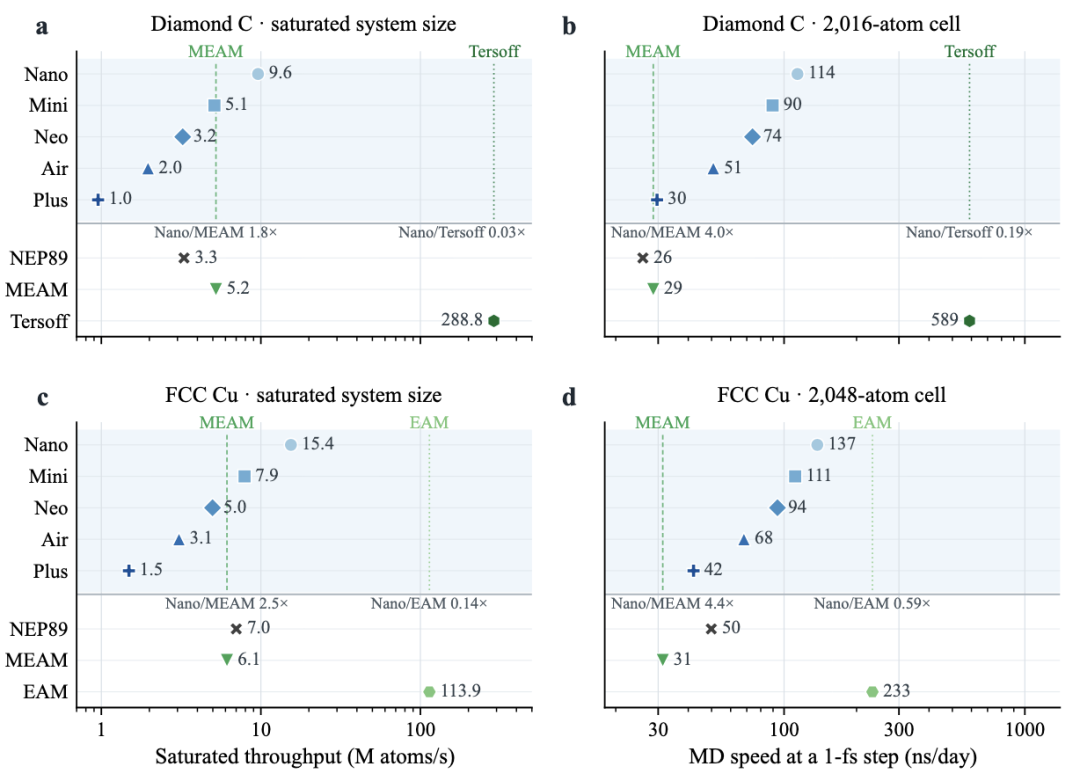
Comparison of saturated throughput and MD speed of DPA4C, empirical potentials, and NEP89 on the same 16-GB V100.
In terms of scale, all five DPA4C variants completed full molecular dynamics simulations of 14,051,520 atoms on a single NVIDIA H20; on 64 nodes and 1024 NVIDIA V100 GPUs at the SAI open-source supercomputing center, the system scaled to 2,048,385,024 atoms, or 2.048 billion, with weak scaling efficiency maintained at 83.3%–91.2%, and the fastest Nano variant achieving an aggregate throughput of 7.67 billion atoms per second.
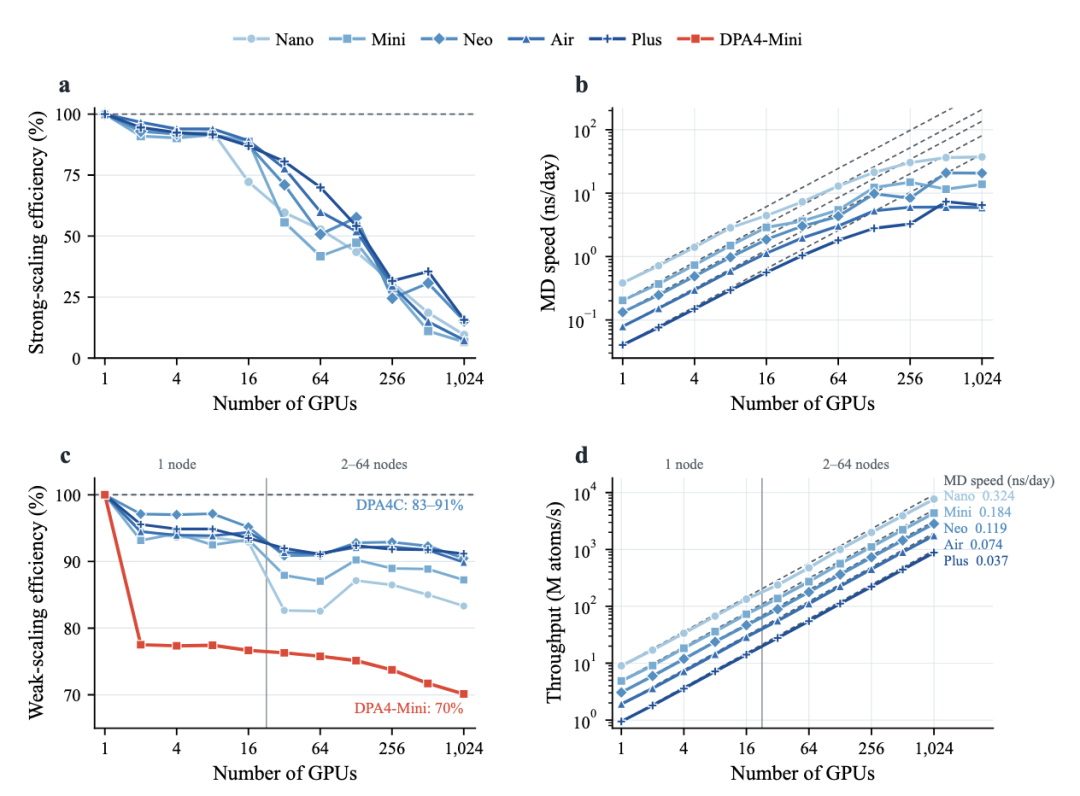
Scaling efficiency of the five DPA4C model sizes on a thousand 16-GB V100 GPUs.
How large is 2.048 billion atoms, exactly? This system is 504×504×1008 diamond unit cells, with side lengths of about 180 × 180 × 360 nanometers. It is large enough to represent a small piece of real material: microstructures such as grains, precipitates, and interfaces, which directly determine material properties, fall exactly on this scale.
What this work truly elevates is the accessibility of problems. Grain boundary segregation, multi-principal element alloys, reaction interfaces, and defect evolution are all stuck in the same place: the systems are multi-component, requiring broad chemical coverage; the energy differences are extremely small, requiring near-first-principles accuracy; and the characteristic scales are tens to hundreds of nanometers, requiring empirical-potential-level speed and scale. In the past, these three conditions could be met at most two at a time; now they can be met simultaneously.
Related Links
DPA4 Paper: https://arxiv.org/abs/2606.02419
DPA4C Paper: https://arxiv.org/abs/2608.19041
DPA4-OMat24 Pre-trained Model: https://www.aissquare.com/models/detail?pageType=models&name=DPA4-OMat24&id=423
DPA4-OMol25_100M Pre-trained Model: https://www.aissquare.com/models/detail?pageType=models&name=DPA4-OMol25_100M&id=434
DPA4C-OMat24 Pre-trained Model: https://www.aissquare.com/models/detail?pageType=models&name=DPA4C-OMat24&id=433
DPA4C-OMol25_100M Pre-trained Model: https://www.aissquare.com/models/detail?pageType=models&name=DPA4C-OMol25_100M&id=435
DPA4/4C Paper Authors: Tiancheng Li, Jianming Xue, Linfeng Zhang, Duo Zhang, Han Wang
Affiliated Institutions: Academy of AI for Science, DP Technology, Peking University, Institute of Applied Physics and Computational Mathematics