What Can DP Do too? | Large Atomic Model DPA2 Enables Cross-Scale Simulations of Complex Nuclear Alloys
Next-generation nuclear fission and fusion reactors impose extremely stringent requirements on structural materials, which must simultaneously withstand high temperatures, high-dose irradiation, and strongly corrosive coolants. Multi-principal element alloys (MPEAs) are regarded as highly promising candidate materials owing to their unique high-entropy effect, lattice distortion, sluggish diffusion, and cocktail effect. Nevertheless, understanding irradiation damage and mechanical behaviors at the atomic scale in these complex alloys demands interatomic potentials (IAPs) with high precision and universal transferability. Although conventional machine learning interatomic potentials (MLIAPs) achieve decent accuracy, the volume of training datasets rises exponentially for quinary or higher-order complex systems, leading to prohibitive computational costs for generating DFT reference labels.
Recently, the research group led by Biao Xu and Huiqiu Deng from Hunan University, together with Chih-Chung Kai from City University of Hong Kong, published the paper Scaling reliable interatomic potentials to complex nuclear alloys via pretrained atomic models in npj Computational Materials. For the first time, the study integrates multi-task physics-informed pretraining with Large Atomic Models (LAMs), and systematically evaluates the performance of IAP construction for the complex nuclear alloy Ta-Nb-W-Mo-V. The DPA2-5E model fine-tuned merely with quinary alloy data not only outperforms conventionally trained MLIAPs built from scratch, but also exhibits robust transferability toward quaternary, ternary, and even binary subsystems. It faithfully reproduces irradiation cascade damage and stress-strain responses.
Dataset and Model Training Strategy: Balancing Structural Diversity and Computational Cost
This study adopts the public dataset of the Ta-Nb-W-Mo-V quinary alloy and all its 30 subsystems spanning unary to quaternary compositions, covering 31 alloy systems in total. The dataset encompasses crystalline configurations with vacancies and interstitials, free surfaces, liquid phases, chemically ordered phases, and transition-state geometries, ensuring full coverage of the configuration space (see Figure 1).
Based on this fixed, representative dataset, the authors systematically compare two training paradigms:
- Fine-tuning the pre-trained large atomic model DPA2: DPA2-5E trained only on quinary alloy data, and DPA2-All trained on all 31 alloy systems.
- Training the baseline DPA1 model from scratch: DPA1-5E trained only on quinary alloy data, and DPA1-All trained on the full dataset.
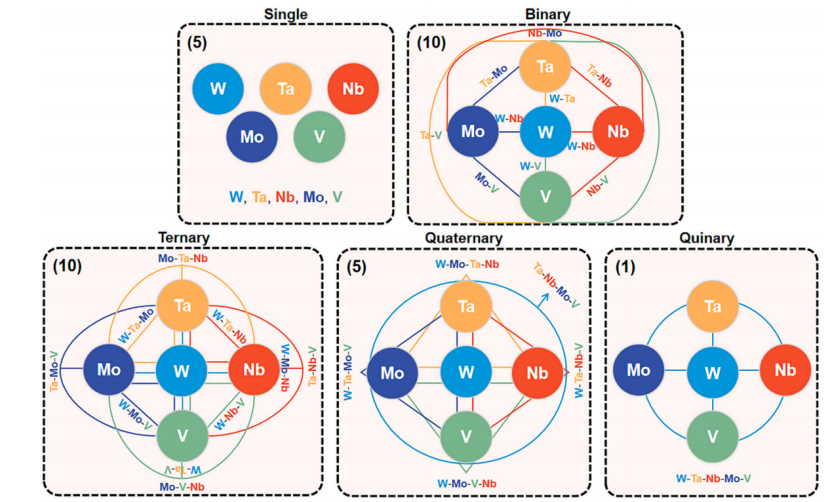
Figure 1 Schematic of the diverse training dataset encompassing the Ta-Nb-W-Mo-V quinary alloy and all its subsystems. Colored circles represent the five constituent elements (W, Ta, Nb, Mo, and V). The colored lines and closed loops connecting or enclosing multiple circles denote alloy subsystems formed by corresponding element combinations. (a) Five unary (single-element) systems; (b) 10 binary combinations; (c) 10 ternary combinations; (d) five quaternary combinations; (e) one quinary system, forming 31 alloy systems in total.
The detailed training workflow is illustrated in Figure 2. The DPA2 model is fine-tuned from the multi-task pretrained checkpoint (DPA2_medium_28_10M_rc0.pt), and knowledge distillation is implemented to generate a lightweight student model for higher computational efficiency. By contrast, the DPA1 model is trained from scratch with identical attention descriptors and neural network architectures.
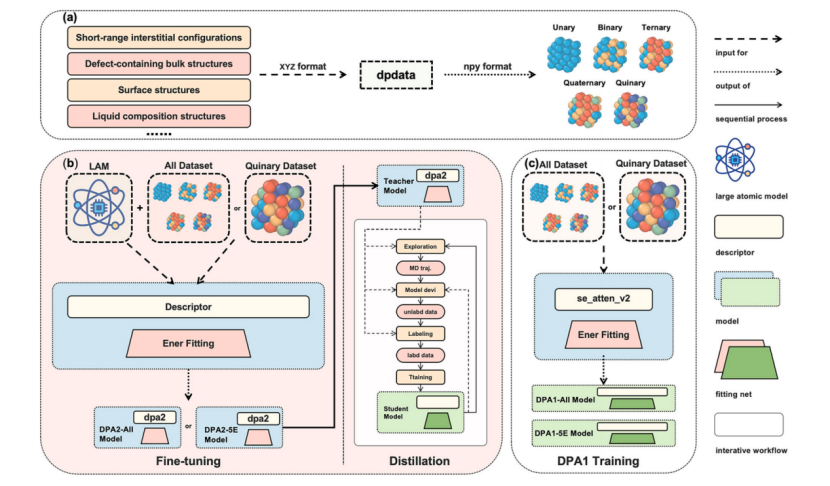
Figure 2 Schematic illustration of the model training workflows. (a) Conversion of dataset formats. (b) Fine-tuning and knowledge distillation procedure for the LAM-based DPA2 model. (c) Training pipeline of the DPA1 baseline model.
Model Accuracy and Transferability: Outstanding Performance under Low-Data Regimes
When trained on the full Dataset-All, DPA2-All achieves lower global root-mean-square errors (RMSEs) for energy and force than DPA1-All and the tabGAP-All potential reported in existing literature. More importantly, under the low-data scenario where only quinary alloy data is used for training, the validation energy and force RMSEs of DPA2-5E are markedly superior to those of DPA1-5E (Figure 3c,d). This result demonstrates that the physical prior knowledge embedded in the multi-task pre-trained large model effectively improves model robustness and generalization even with limited training data.
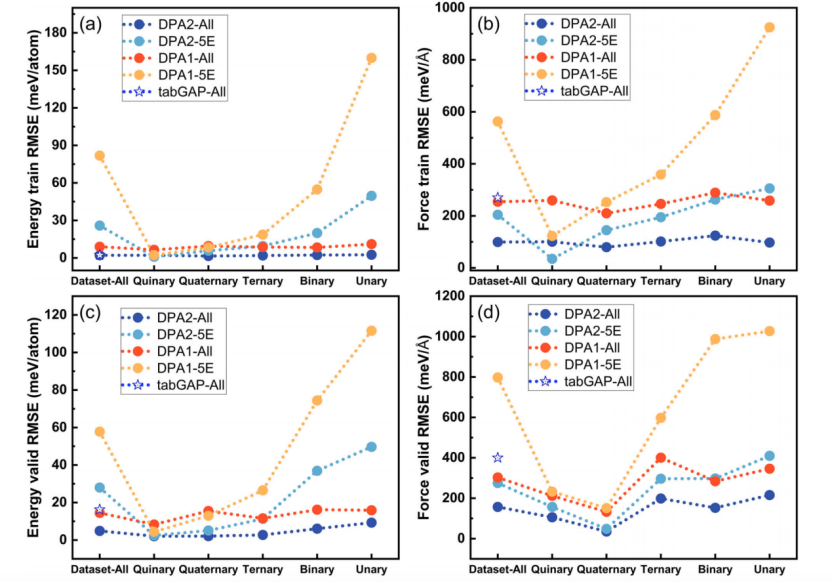
Figure 3 Energy and force prediction performance of five MLIAPs built from different datasets (Dataset-All includes all quinary down to unary data) and training strategies. (a, b) Training errors of five MLIAPs on different datasets. (c, d) Validation errors of five MLIAPs on different datasets. Dark-blue filled circles: DPA2-All; light-blue filled circles: DPA2-5E; dark-orange filled circles: DPA1-All; light-orange filled circles: DPA1-5E; open blue star: reference tabGAP-All potential. Solid lines serve as visual guides.
The study further quantifies the downward transferability of the potentials. DPA2-5E, which is exclusively trained on quinary alloy data, yields prediction errors for quaternary and ternary subsystems nearly equivalent to those of DPA2-All, revealing excellent cross-component transferability. Although DPA1-5E retains moderate transferability, its prediction accuracy degrades far more drastically when extended to lower-order subsystems. This indicates that both model architecture and pretrained physical priors jointly govern transfer performance. This "one model for multiple systems" paradigm drastically cuts the cost of developing individual potentials for each alloy composition.
Irradiation Cascade Simulations: Faithful Reproduction of Defect Evolution
Displacement cascade simulations are performed at 300 K with primary knock-on atom (PKA) energies ranging from 2 keV to 10 keV to compare the predictive power of DPA2-5E and the high-fidelity reference model DPA2-All. For the quinary Ta-Nb-W-Mo-V alloy, quaternary Ta-Nb-W-Mo alloy, and binary Ta-W alloy, the two potentials produce nearly identical numbers of Frenkel pairs at the thermal spike stage and after structural relaxation. No statistically significant discrepancy is observed in the elemental distribution of interstitial defects (Figure 4). It proves that DPA2-5E trained solely on the quinary alloy can precisely capture irradiation damage behaviors, even for untrained lower-order subsystems.
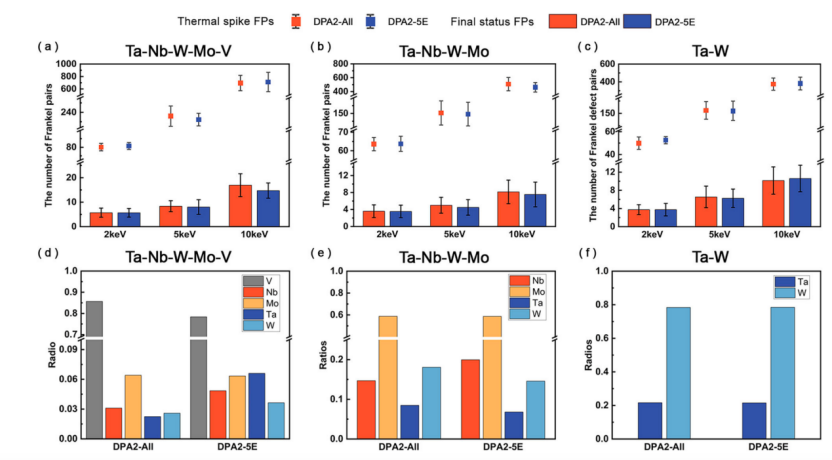
Figure 4 Primary radiation damage outcomes predicted by DPA2-All and DPA2-5E trained only on the quinary alloy dataset. Scatter points denote the number of Frenkel pairs formed at the thermal spike, while bars represent Frenkel pair populations after thermal equilibration at 300 K, plotted against PKA energy for (a) quinary Ta-Nb-W-Mo-V, (b) quaternary Ta-Nb-W-Mo, and (c) binary Ta-W alloys. Red symbols/bars: DPA2-All; blue symbols/bars: DPA2-5E. Error bars represent the standard deviation calculated from 20 independent cascade simulations. Elemental composition of interstitial atoms after relaxation following 10 keV cascades for (d) Ta-Nb-W-Mo-V, (e) Ta-Nb-W-Mo, and (f) Ta-W alloys. Each stacked bar differentiates interstitial fractions of constituent elements (V, Nb, Mo, Ta, W) with distinct color coding.
Mechanical Property Prediction: Temperature Dependence and Systematic Softening
The DPA2-5E potential predicts the temperature-dependent decline of compressive yield strength for Ta-Nb-W-Mo-V, Ta-Nb-W-Mo, and Ta-W alloys, showing excellent consistency with DPA2-All (Figure 5). Quantitatively, DPA2-5E slightly underestimates yield strength, corresponding to systematic softening, and the prediction bias gradually increases when extending from the parent quinary composition to binary subsystems. The authors note that incorporating non-equilibrium structural configurations into the fine-tuning dataset can partially mitigate this issue, yet the improvement remains limited for compositions far from the training quinary alloy. This observation pinpoints the inherent limitation arising from the near-equilibrium bias of the pretraining dataset, and provides clear directions for future optimization.
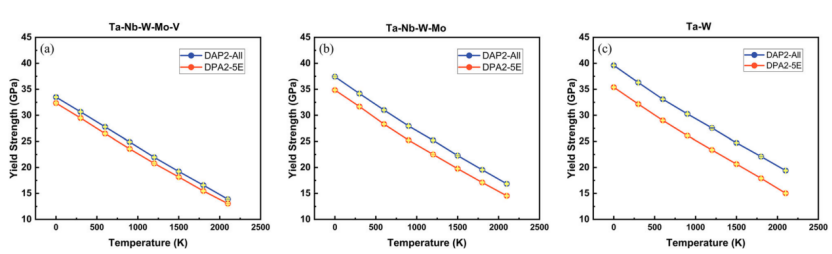
Figure 5 Temperature dependence of compressive yield strength for the parent alloy and its subsystems predicted by LAM-based MLIAPs. Compressive yield strength versus temperature for equimolar Ta-Nb-W-Mo-V, Ta-Nb-W-Mo, and Ta-W alloys, calculated by DPA2-5E and the reference DPA2-All: (a) Ta-Nb-W-Mo-V, (b) Ta-Nb-W-Mo, (c) Ta-W. Blue solid lines: DPA2-All; orange solid lines: DPA2-5E. Yellow markers with vertical error bars denote the mean value and one standard deviation over 10 parallel simulations.
Extended Applications: Complex Microstructures and Corrosive Environments
This framework is not restricted to compositionally complex single-phase alloys. The method is further validated on ordered intermetallics (dual-phase FCC + L1₂ structure in the Ni-Co-Fe-Cr-Al-Ti-Ta system) and a six-component L1₂ alloy exposed to liquid lead-bismuth corrosion with and without oxygen contamination. Even under such extreme structural and environmental complexity, the MLIAP built upon the pretrained LAM achieves high prediction accuracy with minimal additional training data (Figure 6), which verifies the generalizability of this approach.
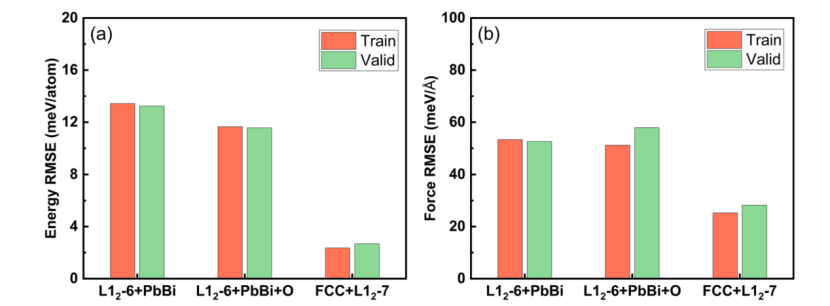
Figure 6 Energy and force prediction errors of MLIAPs developed via the pretrained LAM strategy for three representative complex systems. The "L1₂-6 + PbBi + O" system consists of solid L1₂-6 precipitates (Ni, Co)₃(Al, Ti, Ta, Nb), surrounding liquid Pb-Bi phase, and oxide phases. The "FCC + L1₂-7" system contains a disordered FCC matrix (Ni-Co-Fe-Cr-Al-Ti-Ta) and coherent L1₂ precipitates (Ni, Co)₃(Fe, Cr, Al, Ti, Ta). Orange bars: training RMSE; green bars: validation RMSE. (a) Energy prediction RMSE; (b) force prediction RMSE.
Summary
This work pioneers the application of the multi-task pretrained Large Atomic Model DPA2 in developing interatomic potentials for nuclear structural alloys. The DPA2-5E model fine-tuned only on quinary alloy data strikes an excellent balance among prediction accuracy, cross-component transferability, and computational cost. The potential faithfully reproduces irradiation-induced defect evolution and temperature-dependent mechanical responses, and can be reliably extended to quaternary down to unary subsystems. Moreover, the workflow is adaptable to dual-phase microstructures and material systems under corrosive conditions.
This hierarchical "one model for multiple systems" workflow offers a practical and scalable route for high-throughput screening of complex nuclear materials, cross-comparison among alloy compositions, and long-term atomic-scale damage evolution simulations.
All datasets and training scripts are publicly available at:https://github.com/JiangXiaoMingSan/LAM-DPA-Train-Script