What Can ABACUS+DP Do Too? | Revealing the Key Role of Hydrogen-Bond Networks in Liquid High-Order Harmonic Generation
1. Abstract and Core Highlights
In October 2026, a research team from the Innovation Academy for Precision Measurement Science and Technology, Chinese Academy of Sciences, published a study in Physical Review A titled "Role of a hydrogen-bond network in liquid high-order harmonic generation". Based on the domestic open-source density functional theory software ABACUS, combined with deep potential molecular dynamics (DPMD) and real-time time-dependent density functional theory (rt-TDDFT), this work proposed a quantum multi-channel transition model in energy space, systematically revealing the microscopic mechanism of hydrogen-bond networks in liquid high-order harmonic generation (HHG).
The study found that electronic-state modifications associated with hydrogen bonds produce distinctive harmonic features, clearly different from gas-phase and crystalline-phase cases, providing a new tool for using attosecond spectroscopy to probe hydrogen-bond-related chemical and biological processes in liquids.
2. Research Background
HHG is a powerful tool for probing ultrafast electron dynamics, enabling observation of electronic structure and correlations on attosecond timescales. In dilute gases, HHG can be well described by the three-step model for a single atom or molecule; in crystalline solids, the periodic lattice leads to different mechanisms and scaling laws. Liquids, however, occupy a unique regime: they lack periodicity but exhibit strong intermolecular interactions and structural disorder. Such complex systems can be reduced neither to isolated atoms or molecules nor to crystal unit cells. Therefore, neither the gas-phase nor the crystalline HHG framework can be directly applied to liquids.
Recent liquid HHG experiments have revealed many striking features, especially the first plateau cutoff energy that is insensitive to laser parameters and the emergence of a second plateau structure with a three-Gaussian ellipticity dependence. These observations indicate that the underlying mechanism is closely related to the intrinsic electronic structure of liquids. Hydrogen bond (HB) networks are responsible for many unique physical and chemical properties of liquids and are expected to play an important role in liquid HHG. However, how HB interactions are encoded in liquid HHG spectra remains largely unexplored.
3. Results Overview
(1) Computational Parameter Settings
This study adopts first-principles computational methods, focusing on the influence mechanism of hydrogen-bond networks in liquid water on HHG spectra.
First, the researchers used deep potential molecular dynamics to train a deep potential model based on the SCAN exchange-correlation functional, generating a series of equilibrium configurations of a 64-molecule water supercell, and selected 55 independent snapshots from them for subsequent electronic structure calculations.
Second, the researchers used the domestic open-source first-principles software ABACUS, based on the linear combination of atomic orbitals (LCAO) basis set and the TZDP (triple-zeta plus double polarization) basis set, to calculate the total electronic density of states (DOS) and projected density of states (PDOS), with an 8×8×8 k-point mesh.
Finally, the researchers used the OCTOPUS real-time time-dependent density functional theory package to perform rt-TDDFT simulations, solving the time-dependent Kohn–Sham equations under the frozen-core approximation to obtain laser-induced currents and high-order harmonic spectra. Meanwhile, a simplified hydrogen-bond model was constructed to investigate the physical origin of the ellipticity dependence.
(2) Core Research Results
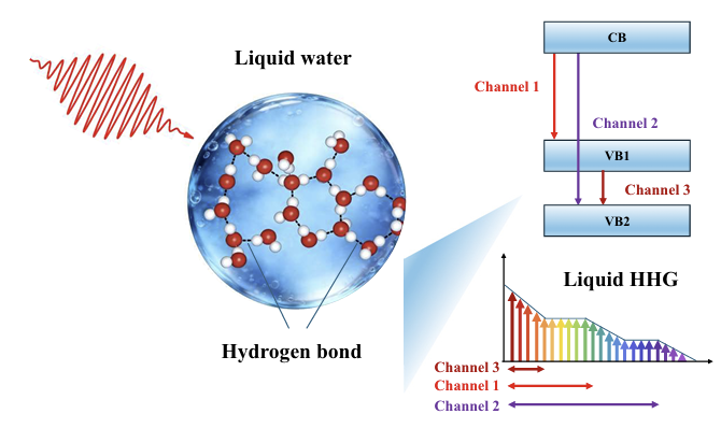
Two-plateau structure: The HHG spectrum of liquid water exhibits a distinct double-plateau structure, with the cutoff energies of the first and second plateaus at about 14 eV and 21 eV, respectively. EDOS analysis shows that these cutoff energies correspond to the energy differences between the conduction band (CB) and different valence bands (VB; such as VB1 and VB2), and are quantitatively consistent with rt-TDDFT simulations and experimental measurements.
Energy-resolved contribution of hydrogen bonds: Hydrogen bonds are not uniformly distributed in liquid water, but are concentrated in a specific energy range (about 15–21 eV). In this energy range, the probability that electronic states spread across multiple molecules to form spatially continuous distributions increases significantly, and the transition dipole moments between the VBs and the CB are also markedly enhanced, indicating that the hydrogen-bond network contributes more strongly to harmonics above the first plateau cutoff.
Valence-band-resolved HHG spectra: By freezing specific valence bands in rt-TDDFT evolution, it was found that when only VB1 is retained the second plateau disappears, whereas the spectra with VB1 and VB2 retained are essentially consistent with the full valence-band results. This indicates that VB2 contains more hydrogen-bond-related electronic states and is crucial for the formation of the second plateau.
Ellipticity dependence: The simplified hydrogen-bond model successfully reproduces the three-Gaussian ellipticity dependence of the second-plateau harmonics observed in experiments, while the non-hydrogen-bond model shows only a single-Gaussian dependence. This confirms that spatially extended electronic states and intermolecular coupling, which are characteristic of hydrogen-bond interactions, can modify the ellipticity dependence of the HHG response.
Universality verification: The theory was generalized to liquid ethanol and isopropanol, and it was found that although their compositions and structures differ significantly, their EDOS are similar in energy space and can therefore produce similar harmonic spectra. Unlike the dense three-dimensional hydrogen-bond network in water, ethanol and isopropanol contain only a single hydroxyl group, supporting only short-range weakly connected hydrogen-bond structures, which leads to weaker second-plateau features.
(3) Analysis of Key Figures
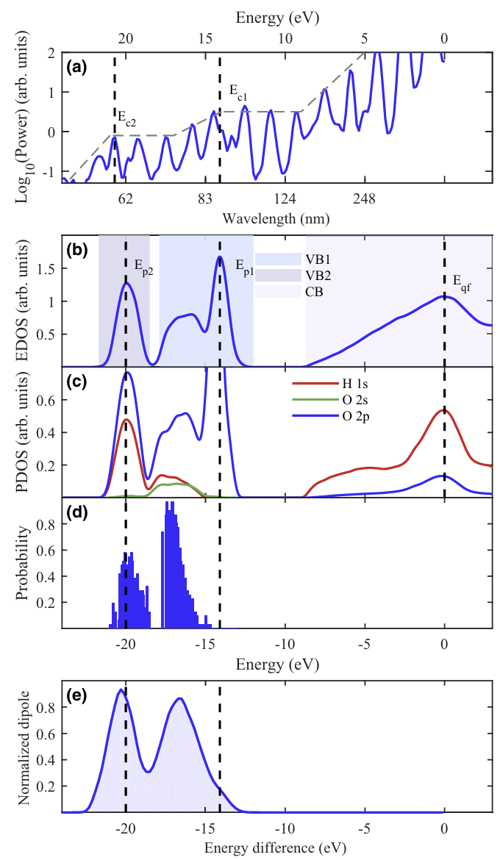
Figure 2: HHG spectrum and intrinsic electronic properties of liquid water. (a) HHG spectrum with a double-plateau structure obtained by coherent averaging over 55 DPMD configurations; (b) total electronic density of states (EDOS); (c) projected density of states (PDOS); (d) energy-resolved probability density of hydrogen bonds; (e) energy-resolved transition dipole moments between the VBs and the CB.
Figure 1 shows a typical snapshot of the hydrogen-bond network in liquid water and the physical picture of the multi-channel transition model in energy space: excited electrons in the conduction band can transition to different valence bands (VB1, VB2), and multi-channel HHG leads to multi-plateau structures in the spectrum.
Figure 2 shows the double-plateau HHG spectrum of liquid water and its corresponding electronic structure characteristics. The characteristic peaks in the EDOS (Ep1≈-14 eV and Ep2≈-20 eV) correspond to the energies of VB1 and VB2, respectively, quantitatively matching the cutoff energies of the two plateaus. Figures 2(d) and 2(e) show that hydrogen-bond-related electronic states are significantly enhanced in the region above the first plateau cutoff, directly linking the hydrogen-bond network to the formation of the second plateau.
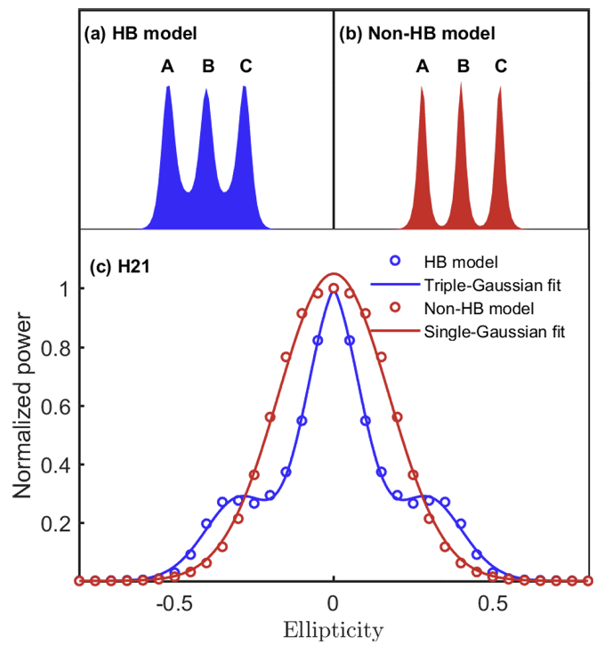
Figure 3: Ellipticity dependence of HHG. (a) and (b) Schematic diagrams of the simplified hydrogen-bond model and the non-hydrogen-bond model; (c) ellipticity dependence of H21 at a wavelength of 800 nm and an intensity of 4.0×10¹³ W/cm². The hydrogen-bond model exhibits a clear three-Gaussian structure, consistent with experimental observations.
Figure 3 reveals the microscopic origin of the ellipticity dependence through the simplified hydrogen-bond model. In the hydrogen-bond model, spatially extended electronic states and intermolecular coupling lead to a three-Gaussian ellipticity dependence of H21, whereas the non-hydrogen-bond model shows only a single-Gaussian dependence. This comparison clearly demonstrates the key role of the hydrogen-bond network in shaping the spectral features of liquid HHG.
4. Research Significance
This work proposes a quantum multi-channel transition model in energy space to explain the microscopic mechanism of liquid high-order harmonic generation. Unlike theories based on semiclassical gas models, this model starts directly from the intrinsic electronic structure and intermolecular coupling of liquids, requires no adjustable empirical parameters, is universal, and can be directly applied to different liquid systems.
The study clearly identifies for the first time the influence of hydrogen-bond-related intermolecular electronic coupling on the HHG of liquid water, revealing its key role in the three-Gaussian ellipticity dependence. This not only fills a gap in the theoretical understanding of liquid HHG, but also opens new avenues for using optical methods with attosecond time resolution to probe hydrogen-bond networks and related physical, chemical, and biological processes in liquids.
At the same time, the study uses the domestic open-source software ABACUS as the core tool for electronic structure calculations, validating the applicability and reliability of domestic open-source computational tools in frontier strong-field physics research and providing an important reference for subsequent similar studies.
5. Bibliographic Information
Paper title: Role of a hydrogen-bond network in liquid high-order harmonic generation
Authors: Zhuang-Wei Ding, Xue-Bin Bian (corresponding author)
Author affiliations: 1. Innovation Academy for Precision Measurement Science and Technology, Chinese Academy of Sciences, Wuhan 430071;
- School of Physical Sciences, University of Chinese Academy of Sciences, Beijing 100049
Journal: Physical Review A, Volume 114, Issue 4, Article 043110
Publication date: October 13, 2026 (received March 2, 2026; accepted September 29, 2026)
DOI: 10.1103/m94b-82wb
Funding support: Natural Science Foundation of Hubei Province (2024AFA029), National Natural Science Foundation of China (12274421), Youth Team Project of the Chinese Academy of Sciences for Basic Research (YSBR-059)