Open-Source Cloud-Native Alloy Property Calculation Workflow APEX V1.3.0 Released | Toward an Agent-Ready Materials Science Infrastructure
Overview of APEX 1.3.0 Core Upgrades
As a key component of the DeepModeling open-source ecosystem, APEX (Alloy Property Explorer) [1] has undergone continuous iterative optimization since the release of V1.2.0, focusing on high-throughput materials property calculation scenarios. These efforts have steadily enhanced workflow automation, computational efficiency, and user experience, driving the AI for Materials (AI4M) infrastructure toward greater intelligence and standardization.
The newly released APEX V1.3.0 introduces comprehensive upgrades across multiple fronts, including automated structure construction, novel property calculation workflows, a graphical user interface (GUI), and task fault-tolerance with diagnostic mechanisms. This release further reduces manual intervention in complex computational pipelines while improving execution stability and traceability.
More importantly, this upgrade marks a critical step for APEX in evolving from a “computational tool” toward a “scientific agent infrastructure”: automated structure generation, standardized task encapsulation, and workflow composability lay the foundation for building materials computation services that can be directly invoked by AI agents. Whether it is composition-aware structure generation, sublattice-aware random solid-solution construction, or batch task management and multi-workflow tracking within the graphical interface, all these features reflect APEX’s significant progression toward an agent-ready research infrastructure.
Intelligent Structure Generation: Making Materials Structure Construction More Efficient and Smarter
In materials property calculations, structure preparation is often the most fundamental yet time-consuming step. For complex systems, the quality of structure construction directly affects the reliability of subsequent calculations and largely determines the efficiency ceiling of high-throughput studies.
To address this challenge, APEX V1.3.0 has systematically upgraded its structure generation module, significantly enhancing automated construction capabilities. The new version can automatically estimate reasonable lattice parameters based on material composition and, in conjunction with compositional constraints and atomic number requirements, automatically generate supercell structures suitable for various computational scenarios.
For typical ordered structure systems such as B2, L1₂, and L1₀, APEX now supports sublattice-aware random solid-solution generation, combined with Warren–Cowley short-range order parameters to achieve physically more realistic configurational sampling. Meanwhile, the workflow can automatically identify parent lattice information and complete the initialization of complex alloy systems based on prototype structures, substantially lowering the modeling barrier for high-entropy alloys, multi-principal-element alloys, and other complex material systems.
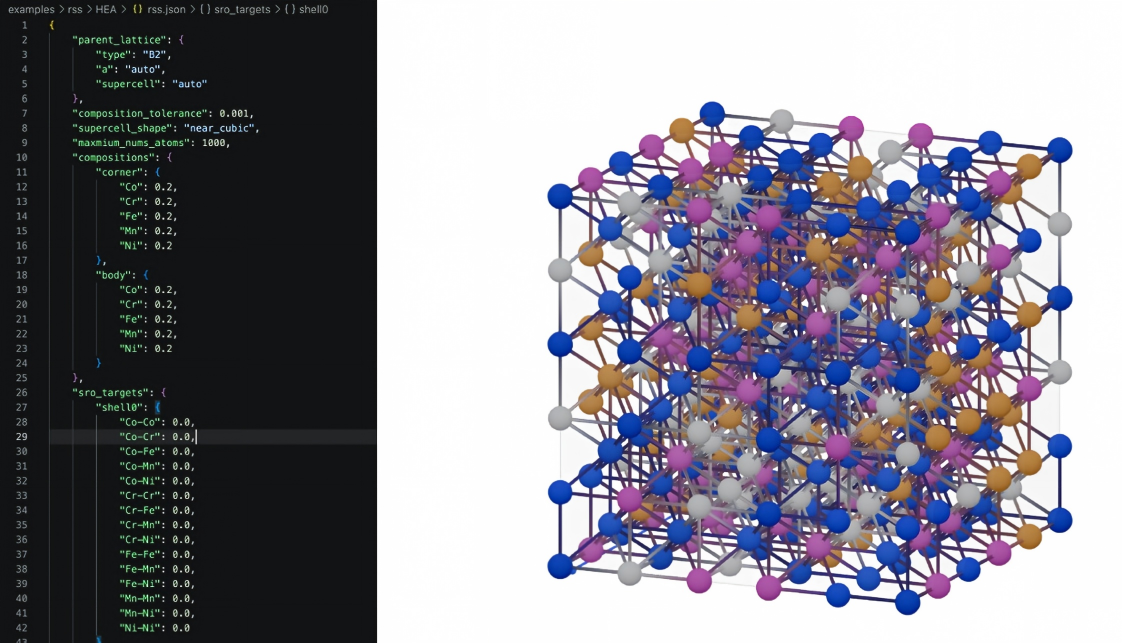
Through these upgrades, APEX can now automatically accomplish the entire pipeline from lattice parameter estimation and supercell construction to complex initial structure generation, providing a more stable and standardized data foundation for high-throughput materials screening and machine-learning interatomic potential training.
Expanding the Boundaries of Materials Property Calculations and Building a More Comprehensive Research Workflow System
After structure automation, the next priority is to cover as many materials property calculation scenarios as possible. However, different material properties often depend on distinct software ecosystems and computational pipelines. Workflow fragmentation, complex parameter configurations, and difficulties in unified result management have persistently constrained high-throughput research.
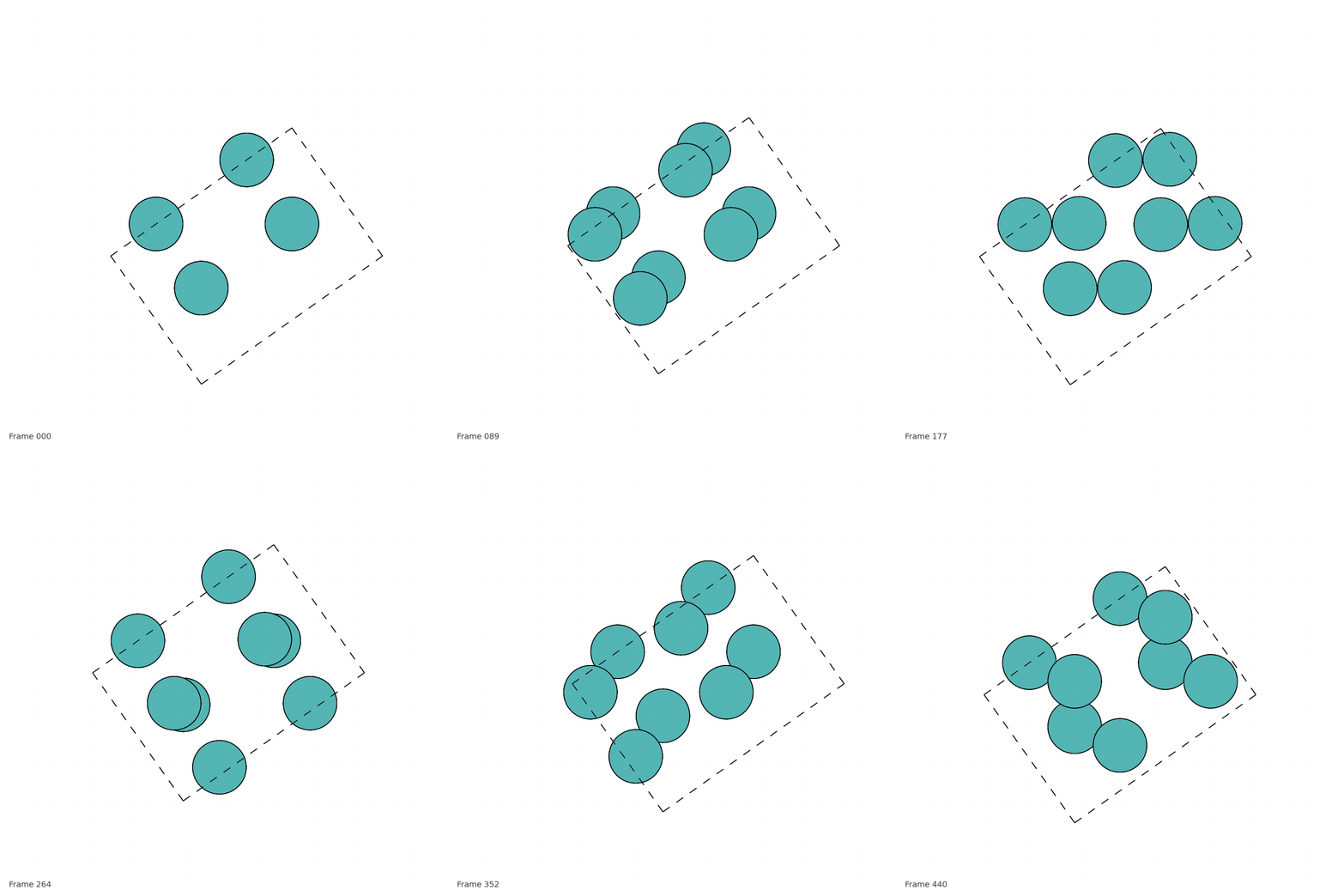
Addressing this pain point, APEX V1.3.0 further expands its materials property calculation workflow landscape by incorporating several new key property calculation capabilities. In the domain of defect and interface property studies, the new version introduces a Gamma‑Surface workflow that enables automated calculation of the generalized stacking-fault energy surface (γ‑surface). APEX significantly streamlines this process through automated workflows and adds a visual preview function before calculation, allowing users to intuitively inspect the fault-migration path prior to job submission, thereby improving the accuracy and efficiency of computational setups.
Furthermore, the new version supports automatic extraction of Grüneisen parameters and, combined with phonon calculation results under various volumetric strains, enables systematic analysis of thermal expansion behavior. It also implements automated computation of elastic tensors, stress responses, and derived mechanical parameters, making it more convenient for researchers to evaluate materials’ mechanical performance under actual service temperatures. Additionally, the finite-temperature lattice workflow has been optimized, with improved thermodynamic information output, temperature-correlation analysis, and lattice-parameter post-processing, further enhancing the reliability of high-temperature structural stability predictions—particularly beneficial for research on high-temperature structural materials and energy materials.
With the addition of these new workflows, APEX has formed a comprehensive materials property calculation framework covering perfect crystals, defective structures, and finite-temperature systems. This enables systematic investigations from 0 K ground states to real service environments, while also providing richer and higher-quality data sources for high-throughput computations, machine-learning interatomic potential training, and AI-driven materials discovery.
Redefining the Research Interaction Experience: Making Advanced Computational Capabilities Accessible
For a long time, high-performance materials computing platforms, despite their powerful capabilities, have relied heavily on complex command-line operations and tedious parameter configurations. For many non-computational materials science researchers, the real barrier lies not in the scientific questions themselves, but in the learning curve of the toolchain. To this end, APEX V1.3.0 has comprehensively upgraded its graphical user interface (GUI), elevating it from an auxiliary tool to a parallel, important interaction entry point alongside the command-line system, providing a more intuitive and efficient experience for researchers with diverse backgrounds.
The new GUI, built on a browser-based architecture, enables a one-stop process for structure upload, calculation configuration, and job submission. The system automatically identifies the input structure type and generates corresponding configuration templates, eliminating substantial repetitive operations. For mainstream computational software such as VASP and ABACUS, the parameter editing experience has also been specifically optimized, with clearer interface logic and more user-friendly presentation of complex computational workflows. Researchers can quickly launch different types of calculation tasks without manually configuring a large number of parameters in the command line.
As research scales up, batch task management becomes a necessity. V1.3.0 supports one-click submission of large configuration ensembles, unified monitoring of multiple workflows, and cross-task result retrieval, allowing users to grasp the running status of dozens or even hundreds of tasks within a single interface, significantly improving research efficiency. Meanwhile, the synergy between APEX and the Bohrium cloud platform has been further refined, with unified account management and default configuration injection enabling seamless transitions from local development to cloud execution. For data-sensitive scenarios, local resource scheduling remains supported, ensuring that computations can be completed on local clusters without data leaving the secured domain. Result presentation and report management have also become more flexible, closing the loop from submission to result interpretation more smoothly.
Building a More Reliable Research Infrastructure
The real challenge of high-throughput computing often lies in scale: once tasks number in the hundreds, failures, environmental fluctuations, and resource anomalies become almost inevitable. To address this, APEX V1.3.0 has undergone comprehensive optimization around task reliability. The new version enhances workflow failure awareness and diagnostic capabilities, automatically terminating subsequent invalid computations upon critical-step anomalies while recording complete execution statuses and diagnostic information to help researchers quickly pinpoint problem sources. At the same time, the platform improves debugging artifact management, enabling unified tracking and retrieval of computational logs, error messages, and intermediate results, thus providing a more adequate basis for complex issue analysis. Furthermore, the platform introduces intelligent recovery and retry mechanisms that automatically identify different failure causes and execute corresponding strategies, improving resource utilization efficiency while ensuring computational correctness; successfully completed steps are automatically skipped with result reuse, avoiding time and resource consumption from redundant recomputation. These improvements are particularly valuable for long-duration, high-concurrency database construction and high-throughput screening efforts.
Integrating into the Agentic Science Ecosystem and Unleashing the Potential of Scientific Agents
Scientific agents are transitioning from conceptual frameworks to practical deployment. In future research, agents will increasingly undertake literature reading, scheme generation, computation execution, and result analysis [2][3]. This evolution also changes the requirements for computing platforms: they must not only compute fast but also be callable in a standardized manner and reproducibly traceable. APEX’s standardized workflows, unified data interfaces, and cloud-native architecture are precisely laid out in anticipation of this trend.
This capability also creates conditions for deep synergy between APEX and next-generation materials science agent platforms such as MatMaster [4]. MatMaster can discover potential design spaces from vast literature and historical data, generating numerous candidate materials along with corresponding schemes, while APEX provides efficient and reliable property calculation and validation capabilities for these candidates. Together, they establish a closed-loop R&D process of “reading–computing–doing,” dramatically improving materials innovation efficiency. Particularly in application scenarios of machine-learning interatomic potentials—such as high-throughput screening, finite-temperature property prediction, and defect structure evaluation—APEX’s continually expanding workflow capabilities provide high-quality data and validation support for agent-driven materials design. As platform standardization deepens, an increasing number of research tools and agents will be able to collaborate based on a unified infrastructure.
Summary and Outlook
APEX V1.3.0, through automated structure generation, expanded property calculation workflows, a comprehensively upgraded GUI, and robust task management mechanisms, further lowers the barrier to entry for materials property calculations while enhancing the efficiency and reliability of large-scale high-throughput research. Looking ahead, the platform will continue to extend its capabilities in defect structures, finite-temperature methods, and multi-scale simulations, promote deeper integration with mainstream computational software such as Quantum ESPRESSO and GROMACS, and build a more open and comprehensive materials computation ecosystem. Moreover, leveraging the Bohrium and SciMaster ecosystems, APEX will continuously improve its synergy with scientific agents, facilitating efficient coupling among materials design, property prediction, computational validation, and experimental feedback, thereby providing a solid computational infrastructure for the AI for Materials ecosystem.
References
[1] APEX repository: https://github.com/deepmodeling/APEX
[2] SciMaster: Towards General-Purpose Scientific AI Agents, Part I. X-Master as Foundation: Can We Lead on Humanity’s Last Exam? https://arxiv.org/abs/2507.05241
[3] Bohrium + SciMaster: Building the Infrastructure and Ecosystem for Agentic Science at Scale. https://arxiv.org/abs/2512.20469
[4] MatMaster: https://github.com/AnguseZhang/MatMaster/tree/main